
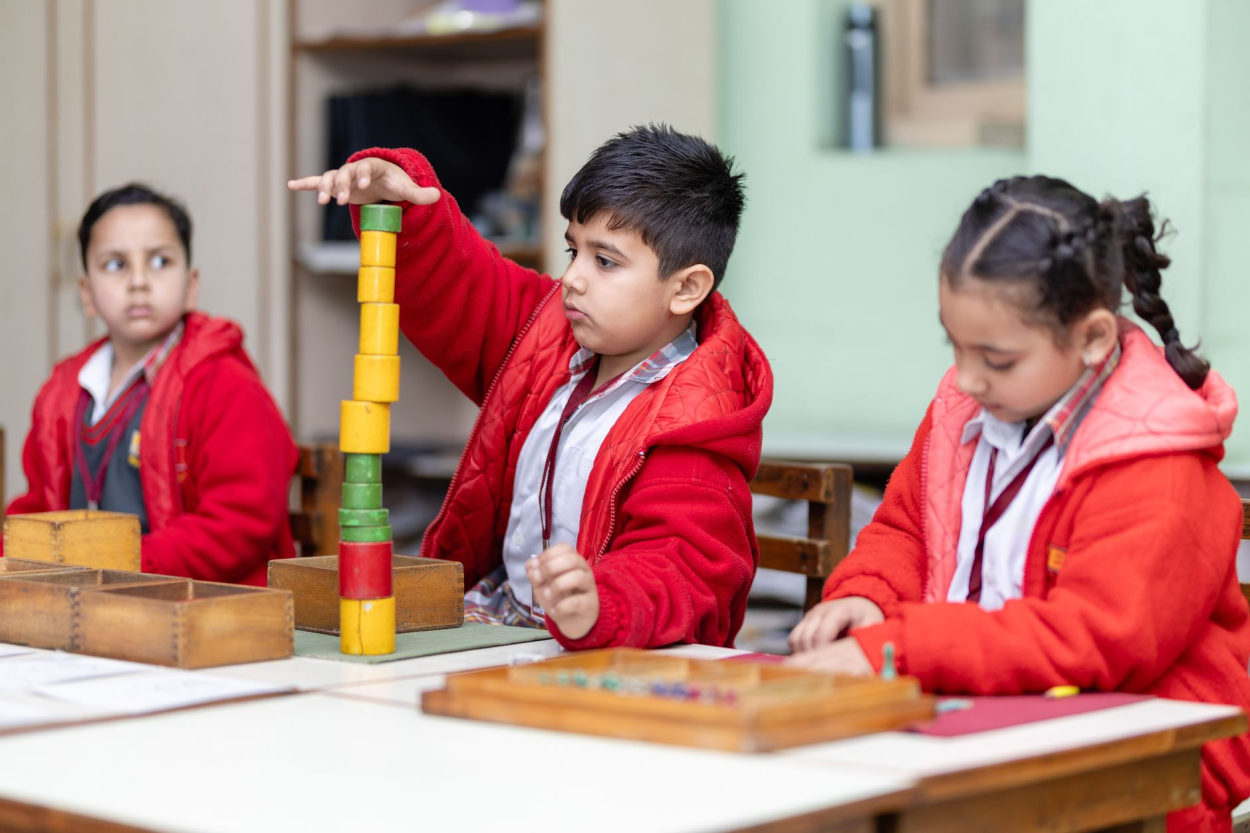
When families first visit a Montessori preschool, one of the most noticeable differences is the age range in the classroom. In a traditional early childhood setting, children are often grouped very narrowly by age. In an authentic Montessori environment, children typically learn in a mixed-age community over a longer cycle. In our experience, this is not a small design detail. It is one of the key reasons Montessori classrooms feel calm, purposeful, and naturally collaborative.
At Montessori Children's House, we see mixed-age learning as a practical way to support children’s development rather than rush it. Younger children are surrounded by examples they can watch and aspire to. Older children strengthen their confidence by helping others, modelling routines, and deepening skills they have already begun to master. This mirrors the way children learn in families and communities, where growth happens through shared experience rather than constant comparison.
If you are new to Montessori, our Montessori approach page gives a helpful overview of the principles behind this way of learning.
A mixed-age Montessori classroom brings together children across a developmental range, commonly across a three-year span in Montessori education. Rather than expecting every child to do the same activity at the same time, the environment is prepared so each child can work at an appropriate stage of readiness. Association Montessori Internationale describes Montessori environments as organised to support the developmental characteristics and interests of a mixed-age group, while Montessori organisations such as the Montessori Foundation explain that mixed-age classrooms function as communities where children learn in different roles over time.
In practice, this means children are not defined only by age. We typically see children move between observing, practising, repeating, helping, and eventually leading. That cycle matters. It creates continuity and allows learning to unfold in a more natural rhythm.
Children do not naturally separate themselves into strict age categories in everyday life. At home, in extended family settings, and in the wider community, they usually encounter babies, toddlers, preschoolers, older children, and adults together. Mixed-age Montessori classrooms intentionally reflect this social reality.
In our experience, children often learn best when they are free to observe before they are expected to perform. A younger child may watch an older child carry a tray carefully, return materials to a shelf, roll a mat, prepare food, or complete a language or numeracy activity. That observation becomes a quiet lesson. Over time, the younger child develops both interest and readiness.
Older children also benefit in ways parents do not always expect. When a child shows a younger peer how to wait for a turn, put away materials, or complete a familiar task, they are not just being helpful. They are consolidating their own learning. We often see that a skill becomes more secure once a child can demonstrate it with patience and confidence.
Observation is a major part of early learning. In mixed-age settings, younger children are constantly exposed to richer language, more advanced practical skills, and stronger social routines. They can watch without the pressure of having to keep up with an entire same-age group. This often leads to more genuine readiness and less performance anxiety.
One of the strongest practical benefits we see is that mixed-age classrooms reduce the pressure of age-based comparison. In same-age groups, children can quickly be labelled as early, average, or behind. In a mixed-age Montessori environment, there is a wider and more normal range of development on display every day. That helps children focus more on their own work and less on ranking themselves against peers.
In healthy mixed-age Montessori communities, leadership is earned through competence and care rather than assigned through reward systems. Older children often become role models simply because they know the routines, understand the materials, and remember what it felt like to be new. We find that this can strengthen empathy, responsibility, and self-control.
Younger children often feel reassured when they can see what is possible. Instead of relying only on adult instruction, they can look around the room and notice children who were once in their place now working confidently and independently. That visible path of growth can be highly motivating.
Te Whāriki describes early childhood learning as something woven together across experiences, relationships, and development. We see strong alignment between that idea and the mixed-age Montessori environment. Children learn that their actions affect others, that materials are shared, that routines support everyone, and that belonging carries responsibility as well as comfort.
If you would like to learn more about our environment, you can explore Our Place to see how we think about the prepared setting for early learning.
| Feature | What it looks like in practice | Why it matters for children |
|---|---|---|
| Observation across ages | Younger children watch older children use materials and follow routines | Builds readiness, confidence, and natural motivation to learn |
| Three-year classroom cycle | Children stay in the same learning community over time | Supports continuity, trust, and deeper relationships |
| Peer modelling | Older children demonstrate care of self, care of environment, and work habits | Strengthens social learning and independence |
| Reduced age-based comparison | Children work at different levels without everyone doing the same task | Allows progress at an individual pace |
| Natural leadership | More experienced children help newcomers | Develops responsibility, patience, and self-esteem |
| Community focus | Children share space, materials, and routines respectfully | Encourages belonging, empathy, and cooperation |
In our experience, not when the environment is carefully prepared and guided well. Montessori classrooms are designed to be orderly, predictable, and scaled to children. Younger children are not expected to do what older children do immediately. They are invited into the classroom community gradually, with plenty of chances to observe, repeat, and build confidence.
We do not typically see that. Older children are not limited by the presence of younger peers. Instead, they often gain depth through mentoring, repeating, and extending what they know. They still receive appropriately challenging lessons, but they also benefit from becoming capable members of the classroom community.
No. This is a common misunderstanding. Mixed-age Montessori classrooms are intentionally structured, but not in a rigid one-size-fits-all way. The order comes from the prepared environment, consistent routines, clear expectations, and thoughtful guidance rather than from having every child complete the same task together.
We see strong compatibility with Te Whāriki, which emphasises holistic development, relationships, belonging, contribution, communication, and exploration. A mixed-age setting can support these outcomes by giving children meaningful opportunities to participate in a real learning community where different strengths and stages are visible and valued.
When we help families settle into Montessori, we often hear early questions about academic pace. Those questions are understandable. Over time, however, many families begin noticing different markers of progress that matter just as much: a child becoming more patient, more independent, more thoughtful with materials, more aware of others, or more capable of persisting with a task.
Those outcomes are not accidental. Mixed-age classrooms create daily opportunities for children to practise self-regulation, cooperation, and concentration in a real social environment. Community discussions among Montessori educators and parents often highlight this same tradeoff: the benefits are not always loud or immediate, but they are often visible in the child’s growing confidence, social maturity, and willingness to learn.
If you are considering a mixed-age Montessori setting for your child, these are the points we suggest keeping in mind:
If you would like to understand more about our philosophy and team, you can visit About Us. If you are exploring enrolment or want to arrange a conversation, you can also contact us.
This article was produced by our internal early childhood education team at Montessori Children's House. We write from our day-to-day experience supporting tamariki and whānau in an authentic Montessori setting in Miramar, Wellington. Our editorial approach combines Montessori practice, knowledge of Te Whāriki, and practical observation from real classroom environments so families can make informed decisions based on how children actually learn and grow.