
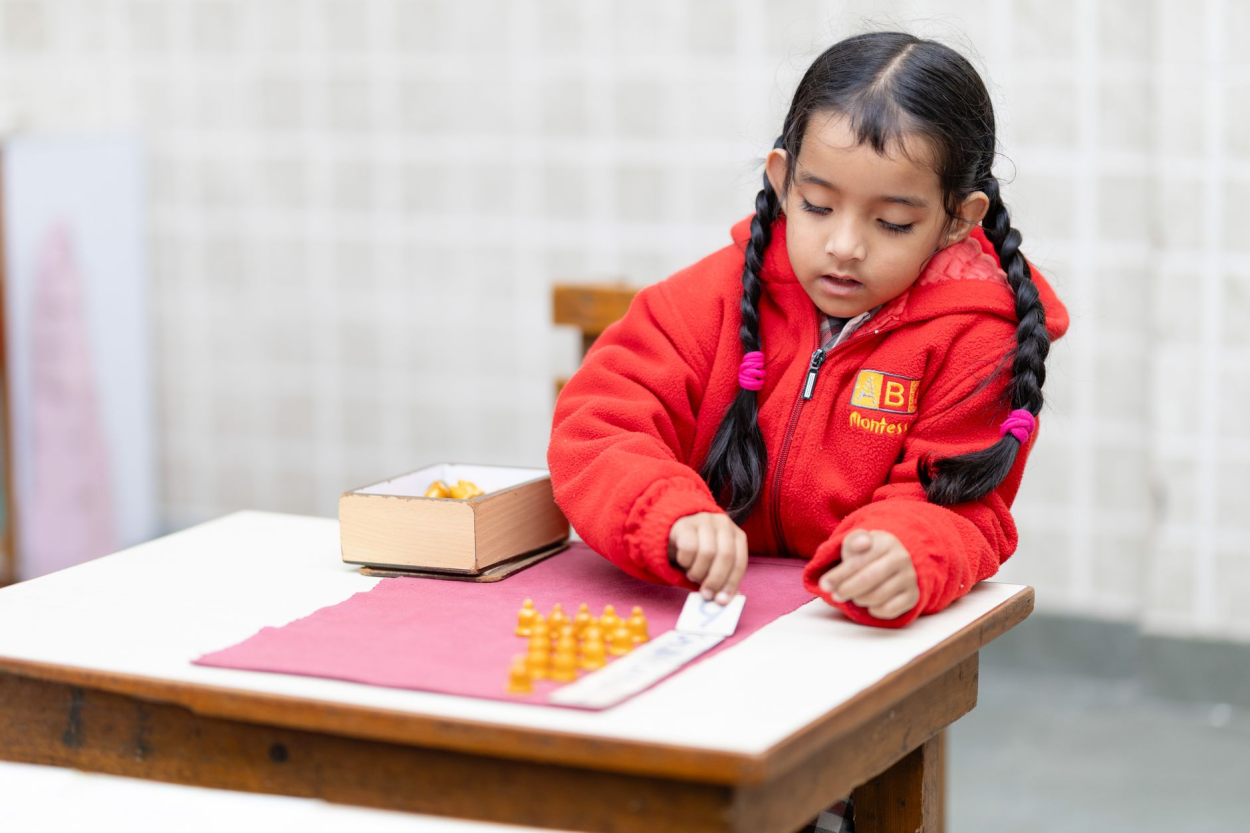
When families ask us about school readiness, we encourage them to think beyond early academics. In our experience, children are most ready for school when they can manage themselves in a group setting, communicate their needs, concentrate on a task, care for their belongings, and approach learning with confidence. Those foundations matter just as much as recognising letters, counting, or holding a pencil.
In a Montessori environment, school readiness develops steadily through the child’s everyday experience. Carefully prepared spaces, purposeful materials, uninterrupted work periods, and respectful adult guidance help children practise the habits that make the transition to school smoother. At Montessori Children’s House, our approach is grounded in authentic Montessori principles and supported by our Montessori approach, Te Whāriki, and a strong commitment to relationships, belonging, and holistic development.
We see school readiness as a combination of practical, social, emotional, physical, and cognitive development. In other words, it is not a race to push formal learning early. It is a process of helping children become capable, secure, engaged learners.
In practical terms, school-ready children are often developing the ability to:
That broad view is consistent with Te Whāriki, which frames early learning around empowerment, holistic development, family and community, and relationships, and describes early childhood education as building confident learners for life.
One of the strengths of Montessori is that readiness is built into the daily rhythm rather than treated as a separate programme. We do not wait until a child is close to school age to begin supporting these capabilities. Instead, we help children build them gradually from the beginning.
Montessori environments are designed so children can do meaningful tasks for themselves. We often see major growth when children begin choosing work independently, returning materials to their place, caring for the environment, and managing routines with less adult intervention. These experiences build initiative and personal responsibility, which are essential for a confident start at school.
In our experience, the ability to focus is one of the most valuable school-readiness skills a child can develop. Montessori materials are hands-on, sequenced, and purposeful, which helps children practise attention and repetition. Over time, children learn to stay with a task, correct mistakes, and experience satisfaction from completing meaningful work.
School readiness depends heavily on language. Children need opportunities to listen, speak, describe, question, and express themselves clearly. In a Montessori setting, we support this through rich conversation, stories, songs, classified language work, practical life experiences, and collaborative social interactions. These help strengthen vocabulary, comprehension, and confidence in communication.
We believe strong foundations matter more than rushing abstract outcomes. Montessori materials allow children to explore sound, symbol, quantity, order, pattern, and sequence in concrete ways before moving toward abstraction. This can make early reading, writing, and maths concepts more meaningful because children have already built understanding through their senses and movement.
Starting school requires children to function within a wider social world. Mixed-age Montessori communities give children daily opportunities to wait, observe, take turns, ask for help, help others, and resolve small social challenges. We typically see that these experiences support both empathy and self-regulation. Children are not only learning alongside others; they are learning how to be with others.
| Montessori area of experience | What children practise | Why it supports school readiness |
|---|---|---|
| Practical life | Self-care, order, coordination, responsibility, following steps | Helps children manage routines, belongings, and classroom expectations |
| Sensorial work | Observation, comparison, classification, attention to detail | Builds cognitive organisation and preparation for later academic concepts |
| Language | Listening, vocabulary, conversation, sound awareness, expression | Supports communication, comprehension, and early literacy confidence |
| Mathematics | Quantity, sequence, pattern, one-to-one correspondence | Develops strong concrete foundations for early numeracy |
| Grace and courtesy | Turn-taking, respect, greeting, conflict navigation, group participation | Strengthens social readiness and positive classroom participation |
| Uninterrupted work periods | Choice, concentration, persistence, task completion | Supports attention span, motivation, and independent learning habits |
Families sometimes worry that if learning feels calm, practical, or play-rich, their child may not be doing enough to prepare for school. We understand that concern, but in our experience the children who transition most smoothly are not necessarily the ones who have memorised the most facts earliest. They are often the ones who can settle, listen, cope with change, work through frustration, and stay engaged.
This is one reason we value a prepared environment so highly. It gives children structured opportunities to develop internal discipline rather than relying only on adult direction. Those internal capacities often become highly visible once children move into a primary classroom.
In Aotearoa New Zealand, school readiness should be understood within the wider context of early learning, identity, belonging, and relationships. Te Whāriki emphasises empowerment, holistic development, family and community, and responsive relationships. We see these ideas as highly compatible with authentic Montessori practice.
For example, a child who feels secure and respected is more available for learning. A child who experiences belonging is more confident in new social settings. A child who is trusted to participate meaningfully in daily life is more likely to develop capability and agency. These are not extras around learning; they are part of the foundation.
Our team also recognises that readiness includes the environment around the child. The physical setting, the emotional tone, the consistency of routines, and the partnership with whānau all shape how prepared a child feels. Families who would like to understand more about our environment can explore our learning environment and read more about our approach and values.
When we speak with families, we often suggest looking for signs of readiness support in everyday practice rather than in marketing language alone. Useful questions include:
These questions usually reveal more about school preparation than a narrow checklist of academic milestones.
If you want to support school readiness at home, we generally recommend focusing on everyday independence and confidence-building experiences. Children benefit when they can unpack their bag, put on shoes, help prepare food, tidy up, carry out simple routines, and speak for themselves in age-appropriate ways. Reading together, allowing time for uninterrupted play, and encouraging persistence with manageable tasks can also make a meaningful difference.
Most importantly, we encourage families not to treat school readiness as pressure. Children thrive when preparation feels secure, respectful, and responsive to their development. If you would like to talk with us about how Montessori supports this journey, we welcome families to get in touch with our team.
This article was produced by our internal early childhood education team at Montessori Children’s House. We draw on our day-to-day experience supporting children and whānau in an authentic Montessori setting in Miramar, Wellington, alongside our ongoing engagement with Te Whāriki, child development practice, and transition-to-school readiness in the New Zealand early learning context. Our editorial approach combines practical experience from the classroom with careful review of relevant public guidance so families receive clear, trustworthy, and usable information.