
When families ask us about school readiness, they are often really asking two questions at once: Will my child be ready for primary school? and Do they need to start formal academics now? In our experience, those questions are related, but they are not the same thing.
We do not believe children need to be pushed into formal academics too early in order to thrive later. In an authentic Montessori setting, readiness for school grows from strong foundations: independence, concentration, communication, coordination, confidence, curiosity, and the ability to participate in a community. Those are the capacities that help children settle, engage, and keep learning once they begin school.
At Montessori Children's House, our approach is grounded in Montessori principles and supported by Te Whāriki, New Zealand's early childhood curriculum. If you would like to understand more about our philosophy, you can explore our Montessori approach, learn more about us, or see our learning environment.
In practice, school readiness is much broader than knowing letters, numbers, or how to complete teacher-directed tasks. We typically see the smoothest transitions to school when children are developing the ability to:
That broader view is consistent with Te Whāriki, which describes early learning as play-based and focused on children growing as capable, confident learners across social, emotional, physical, language, and cognitive domains. It also reflects well-established early childhood guidance that school readiness involves the whole child, not just early academic performance.
We understand why some families feel pressure to start formal academics sooner. School can seem increasingly performance-focused, and parents naturally want their child to feel confident. But in our experience, early pressure can create the wrong kind of preparation.
When children are pushed into abstract, adult-led academic work before they are developmentally ready, we often see tradeoffs. A child may learn to perform a narrow skill on cue, but without the underlying foundations of attention, hand control, oral language, emotional regulation, and internal motivation. That can make later learning more fragile, not more secure.
We also find that early worksheet-style learning can displace the very experiences that build readiness most powerfully: purposeful movement, hands-on exploration, imaginative language, practical responsibility, rich conversation, and uninterrupted concentration.
This is one reason Montessori differs from a "push down" model of education. Rather than treating early childhood as a race toward formal instruction, we treat it as a critical period for building the habits, dispositions, and developmental capacities that make later academics meaningful.
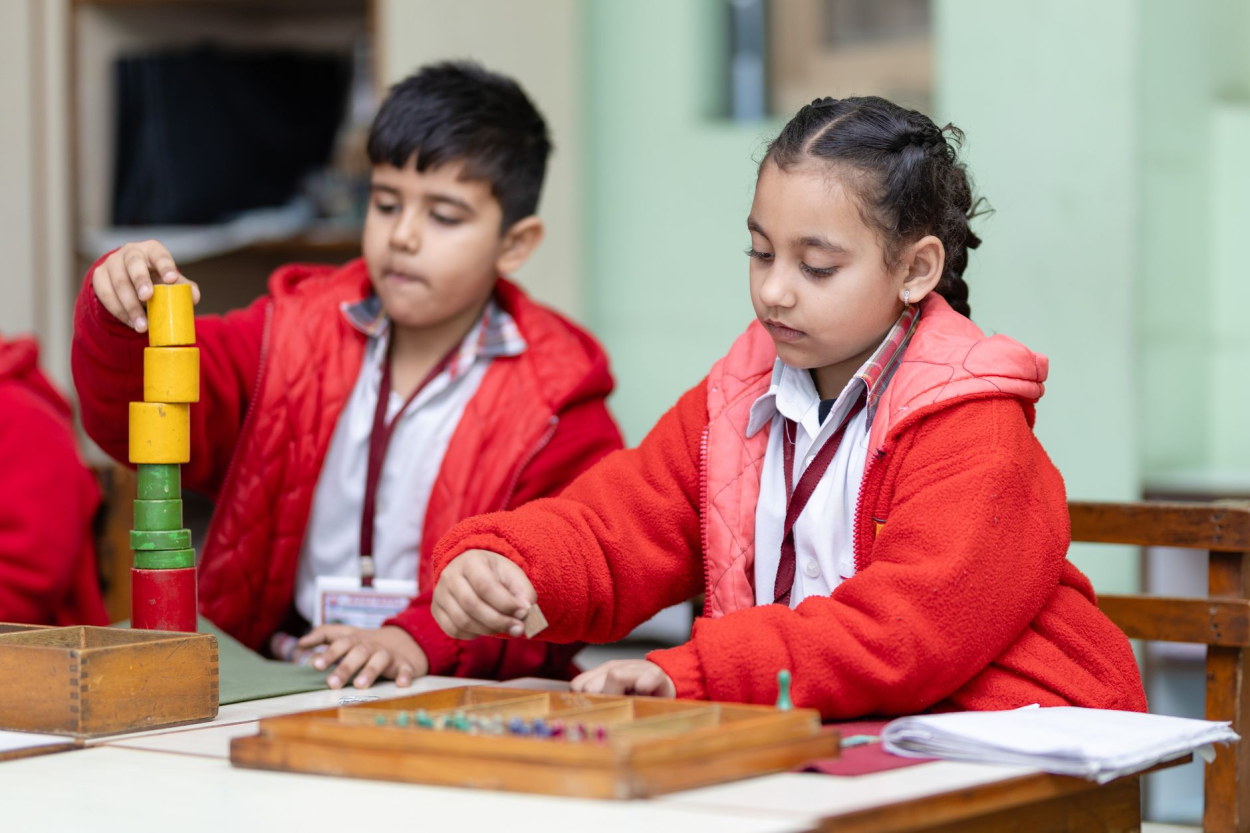
In a well-prepared Montessori environment, school readiness is not separated into a special crash course. It is woven into everyday life. Children prepare for school by doing real, purposeful work that matches their stage of development and gradually increases their independence and competence.
Practical life activities are often underestimated by adults who are looking for obvious academic outcomes. Yet these experiences are some of the strongest preparation for school.
When children pour, spoon, dress themselves, wash hands carefully, prepare food, tidy up, carry trays, and return materials to their place, they are learning much more than a task. They are building sequencing, coordination, attention to detail, perseverance, and a sense of responsibility. They are also developing the confidence that comes from being able to do things for themselves.
By the time children transition to school, these habits help them manage routines, care for belongings, follow multi-step processes, and participate with less adult dependence.
Montessori sensorial materials help children classify, compare, notice patterns, and refine perception. Those experiences may not look like formal maths or literacy at first glance, but they help organise the mind for both.
When children sort by dimension, compare size, grade colour, match sound, or discriminate texture, they are learning to observe carefully and recognise difference and order. These are foundational thinking skills for reading, writing, mathematics, and scientific reasoning.
We often remind families that strong early language is one of the best indicators of later success in school. In Montessori, language is not reduced to drilling isolated facts. Instead, it is built through rich conversation, precise vocabulary, stories, songs, classified materials, grace and courtesy, and hands-on experiences that give words real meaning.
Children who can express ideas, ask questions, listen to others, and understand increasingly complex language are much better prepared to engage with literacy instruction when it becomes more formal.
Montessori environments also support emergent literacy in concrete ways. Children develop auditory discrimination, vocabulary, left-to-right awareness, hand strength, pencil control, and an understanding that symbols carry meaning. When reading and writing emerge from these foundations, they are typically more connected and less forced.
One of Montessori's strengths is that mathematical thinking begins with concrete experience. Quantity, sequence, order, comparison, pattern, and one-to-one correspondence are encountered through materials children can touch and manipulate.
That means children are not simply memorising number facts without understanding. They are building number sense through experience. In our experience, this helps children enter school with a more secure relationship to mathematics, even when they have not been pushed through formal paper-based tasks prematurely.
Some of the most important school-readiness gains in Montessori are easy to miss if adults focus only on visible academics. We pay close attention to concentration, self-regulation, working memory, flexible thinking, and the ability to persist.
When a child chooses work, carries it carefully, completes a sequence, corrects errors, repeats an activity, and returns materials independently, they are exercising precisely the kinds of executive function skills that support success in school. These capacities help children listen, remember instructions, shift between tasks, cope with frustration, and stay engaged.
Starting school is not just an academic transition. It is a social one. Children need to enter a group environment where they can wait, observe, ask for help appropriately, negotiate space, and contribute to the community.
Montessori supports this through grace and courtesy lessons, mixed-age community life, conflict guidance, and consistent expectations around respect for self, others, and the environment. We often see that children who have practised these skills are better able to settle into new school routines and relationships.
| Focus area | Montessori approach | Push-formal-academics-early approach |
|---|---|---|
| Learning pace | Follows developmental readiness and individual progress | Often driven by age-based expectations and external pressure |
| Core method | Hands-on, purposeful, self-directed learning | More adult-directed, abstract, or worksheet-based tasks |
| School readiness goal | Builds independence, concentration, confidence, and understanding | Prioritises early visible performance in narrow academic skills |
| Literacy and maths | Developed through concrete experiences and meaningful repetition | Can be introduced before underlying foundations are secure |
| Motivation | Supports intrinsic motivation and curiosity | Can increase compliance but reduce joy or ownership |
| Long-term effect | Aims for durable habits of learning | May create uneven foundations if rushed |
As an early childhood centre in Aotearoa New Zealand, we think school readiness should be understood in the context of Te Whāriki as well as Montessori. Te Whāriki emphasises empowerment, holistic development, family and community, and relationships. It also recognises that children learn through play, participation, belonging, communication, and exploration.
That matters because it reinforces a key point: early learning is not meant to become a scaled-down version of formal schooling. Instead, it should provide a rich foundation for lifelong learning, identity, wellbeing, and confident participation.
For us, Montessori and Te Whāriki work well together in this area. Both support respectful teaching, responsive environments, and learning experiences that see the child as capable. Both value the development of the whole child rather than measuring readiness only by early academic display.
If you are evaluating early childhood options, we suggest looking beyond simple claims that children will be "ahead" by the time they start school. In our experience, stronger questions include:
These indicators usually tell us far more than whether a child can already complete formal tasks on demand.
In our experience, children are less likely to fall behind when they have strong foundations. A child who can listen, communicate, concentrate, manage themselves, and engage confidently with materials is in a strong position to learn academic content well.
Children benefit from exposure to language, books, stories, counting, pattern, sound awareness, and meaningful number experiences before school. The key difference is how this happens. We favour concrete, engaging, developmentally respectful preparation over premature formalisation.
Montessori is especially helpful here because it allows children to move into more advanced work when they are genuinely ready, without making that pace the expectation for everyone else. We can follow the child without turning early childhood into a pressured academic race.
If you want to support school readiness at home without pushing formal academics too early, we generally recommend:
If you would like to talk with us about how this looks in practice, families are welcome to contact us.
We believe the best preparation for school is not early pressure. It is thoughtful preparation of the whole child. In Montessori, children build the inner tools that formal learning depends on: order, attention, coordination, language, independence, self-discipline, and joy in purposeful work.
That is why Montessori can support strong school readiness without pushing formal academics too early. In our experience, children do best when they are not rushed past childhood, but carefully supported through it.
This article was produced by our internal early childhood education team at Montessori Children's House. We draw on our day-to-day experience supporting tamariki in an authentic Montessori environment in Miramar, Wellington, alongside ongoing review of recognised early childhood guidance, curriculum frameworks, and school-transition practice. Our editorial approach is grounded in Montessori principles, informed by Te Whāriki, and shaped by what we see work in real learning environments with children and whānau.