Choosing a preschool is one of the most important early decisions many families make. In our experience speaking with Wellington parents, the real question is usually not whether one model is universally “better,” but which learning environment best fits a child’s temperament, stage of development, and family values.
Both Montessori and traditional preschool settings can support young children well. The difference is in how learning is organised, how adults guide children, how independence is developed, and what the day feels like in practice. At our centre, we work from authentic Montessori principles while also recognising the New Zealand early childhood context, including our Montessori approach, Te Whāriki, and the importance of relationships, belonging, and bicultural practice in Aotearoa.
For parents comparing options in Wellington, we usually recommend looking beyond brochure language and asking: How much choice does my child have? How are routines handled? What does concentration look like here? How do teachers respond to different developmental stages? Those questions often reveal far more than labels alone.
| Area | Montessori preschool | Traditional preschool |
|---|---|---|
| Learning structure | Child-led within a carefully prepared environment | Usually teacher-planned with more group-led activities |
| Classroom layout | Purposeful materials displayed in sequence and within reach | Activity areas often organised around themes, play stations, and teacher setups |
| Teacher role | Guide, observer, and intentional presenter of materials | Leader, facilitator, and organiser of group experiences |
| Daily rhythm | Longer uninterrupted work periods are common | More transitions between activities, mat times, and group sessions |
| Mixed ages | Often mixed-age groupings, especially in 3 to 6 environments | More commonly same-age or narrower age bands |
| Independence | Explicitly taught through practical life, choice, and self-care routines | Supported, but often within more adult-directed routines |
| Materials | Specialised hands-on Montessori materials with a clear learning purpose | Broader mix of open-ended toys, craft materials, and thematic resources |
| Group teaching | Usually less central than individual or small-group lessons | Often a major part of the day |
| School readiness | Often emphasises independence, concentration, order, and self-management | Often emphasises group participation, routines, and broad exposure to activities |
The biggest difference we see is that Montessori is not simply a set of educational toys or a quieter version of preschool. It is a distinct way of organising learning. Authentic Montessori environments are built around trained adults, mixed-age community, hands-on materials, child-directed work, and uninterrupted work periods. External Montessori guidance also consistently describes these as core features of Montessori classrooms.
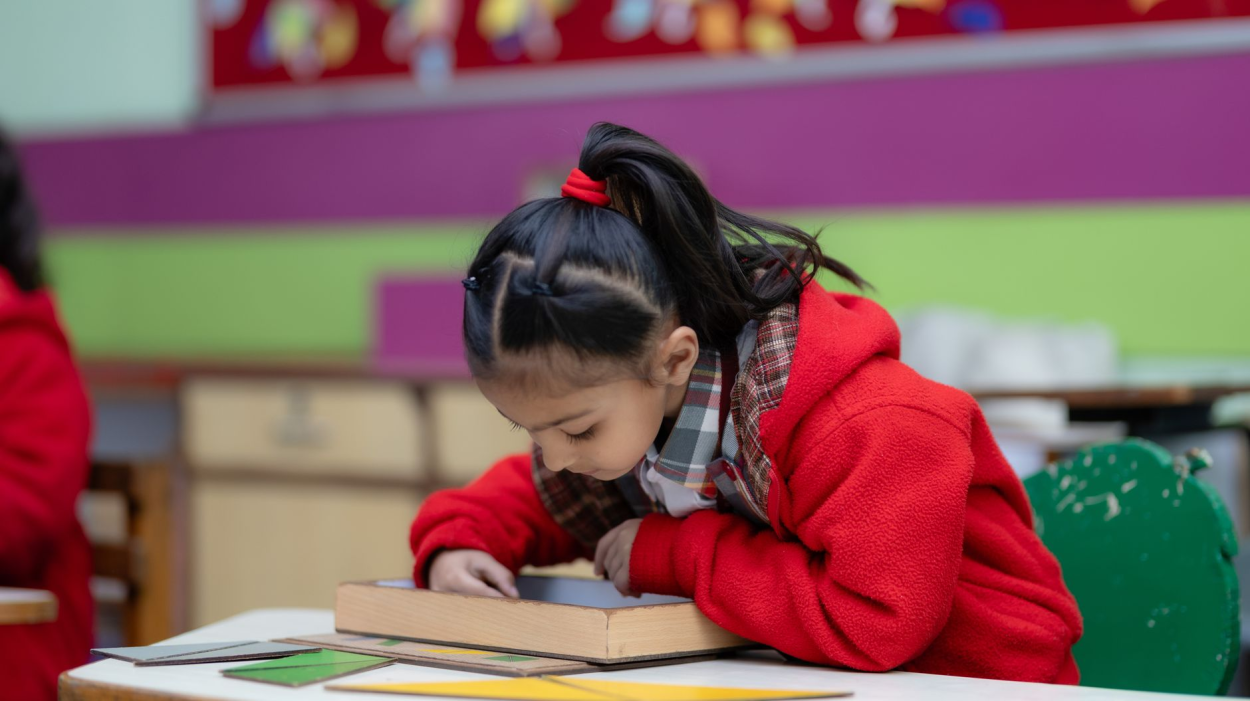
In practice, that means children are not constantly moved as a group from one adult-planned activity to the next. Instead, we prepare an environment where they can choose purposeful work, repeat it, develop concentration, and build confidence through real success. We often see children become more settled when they are allowed enough time to finish what they started.
Traditional preschools, by contrast, often place more emphasis on whole-group experiences, rotating activities, free play blocks, craft tables, teacher-led themes, songs, and shared mat times. That can suit children who thrive on a lively social rhythm and frequent adult direction. It can also be a very warm and effective model when teachers are highly responsive and reflective.
The key point for parents is this: Montessori generally structures freedom inside order, while traditional preschool often structures learning through a broader mix of teacher-led and child-led experiences.
One of the clearest differences between settings is what the adult is doing minute to minute. In Montessori, we expect teachers to observe closely, present materials precisely, step back when appropriate, and intervene thoughtfully rather than constantly. That does not mean adults are passive. In fact, strong Montessori practice requires a great deal of intentionality, consistency, and environmental preparation.
In many traditional preschool settings, teachers are more visibly active in managing the pace of the room, gathering groups together, introducing activities, and shaping the day through collective routines. Neither approach is automatically right or wrong, but they feel different to the child.
When parents visit, we suggest watching for this: Are children always waiting for adult direction, or are they confidently initiating meaningful activity on their own? The answer tells you a great deal about the learning culture.
Many families are first drawn to Montessori because they want their child to become more independent. In our experience, this is one of the most visible strengths of an authentic Montessori environment. Independence is not treated as an optional extra; it is woven into the day through practical life activities, care of self, care of the environment, choice, responsibility, and repetition.
That can look simple from the outside: putting on shoes, carrying a tray carefully, returning work to the shelf, serving food, cleaning a spill, waiting for a turn, or completing a task without immediate adult rescue. But over time, these experiences support competence, self-belief, coordination, and persistence.
Traditional preschools can also foster independence, of course, but the pathway is often less systematic. In many settings, the timetable itself requires more adult-led transitions, which can reduce the amount of uninterrupted self-directed practice a child gets during the day.
For some children, that difference matters a great deal. We often see that children who are capable but hesitant benefit from an environment that gently expects them to do more for themselves.
Some parents worry that Montessori might be too individual or not social enough. In our experience, that concern usually comes from equating “social learning” only with large-group activities. Montessori social development tends to look different. Children learn to work alongside others, observe, wait, negotiate space, seek help appropriately, and participate in a respectful classroom community.
Mixed-age settings can be especially valuable here. Younger children often learn by watching older peers, while older children reinforce their own confidence and leadership through helping, modelling, and showing care. Montessori organisations in both New Zealand and internationally commonly describe mixed-age community as a core part of the approach.
Traditional preschools may offer more obvious group social experiences through mat times, teacher-led games, collaborative art, and group projects. Some children love that energy. Others become overstimulated by it. This is why we encourage parents to think less in slogans and more in terms of fit.
For New Zealand families, one important question is whether Montessori aligns with local early childhood expectations. The answer is yes, when it is practised thoughtfully and authentically. Te Whāriki is the curriculum framework that guides early childhood learning in Aotearoa New Zealand, and the Ministry of Education describes it as a play-based curriculum intended to include the full range of experiences, activities, and events that happen in an early learning setting.
That matters because Montessori in New Zealand does not exist outside the local curriculum context. In our setting, we see strong alignment between Montessori practice and key Te Whāriki ideas such as empowerment, holistic development, family and community, and relationships. We also recognise the importance of bicultural practice and the Treaty of Waitangi in shaping respectful, place-based early childhood education in Wellington.
Parents do not need to choose between a globally recognised educational philosophy and a locally grounded early childhood framework. A strong centre should be able to demonstrate both.
We believe parents deserve a balanced comparison. Traditional preschools may be a strong fit when families want a highly expressive, group-oriented, play-rich environment with frequent teacher-led shared experiences. Some children genuinely flourish in settings with lots of collaborative projects, imaginative group play, music circles, and regular transitions.
Traditional models can also feel more familiar to parents because they often resemble the early schooling structures adults recognise from their own experience. That familiarity can make the environment easier to interpret during visits.
The main question is whether the setting is intentional. A good traditional preschool is not “less serious” than Montessori. It simply organises learning differently.
We also suggest observing the classroom before focusing on displays or marketing language. Look for calm purpose, respectful interactions, and children who seem meaningfully engaged rather than simply occupied.
In our experience, Montessori can be especially helpful for children who benefit from order, repetition, hands-on learning, and a calmer pace. It often suits families who value independence, concentration, courtesy, and practical capability as much as early academic exposure.
It can also be a strong option for parents who want a preschool environment where children are trusted to do real things for themselves, with guidance that is warm but not over-directive. If that resonates with your family, you may find it helpful to learn more about our learning environment and how we prepare spaces for purposeful exploration.
A traditional preschool may be the better match if your child thrives on lively group participation, broad free-play choices, frequent collaborative activities, and a more externally structured day. Some families also prefer a setting where the rhythm feels more visibly social and teacher-led.
For many parents, the deciding factor is not the label but the emotional tone of the environment. If your child is energised by group experiences and broad expressive play, a traditional model may feel more natural.
If we could give Wellington parents one practical piece of advice, it would be this: choose the environment based on what your child needs to become more capable, settled, and confident, not on which label sounds best.
Ultimately, the best preschool is one where your child is known well, treated with respect, and supported to grow in confidence, capability, and joy.
This article was produced by our internal early childhood education team at Montessori Children's House. We write from our experience supporting young children and families in an authentic Montessori preschool setting in Miramar, Wellington. Our editorial process draws on day-to-day practice, curriculum knowledge, family conversations, and review of reputable public guidance relevant to early learning in Aotearoa New Zealand. We aim to give parents practical, trustworthy information grounded in both professional practice and the realities of choosing childcare and preschool locally.