Choosing a preschool is rarely about finding a universally “best” method. In our experience, it is about finding the learning environment that best matches your child’s temperament, developmental stage, and family values. Parents often compare Montessori with traditional preschool as though one must be better in every situation, but we usually find the more useful question is: Which environment will help this particular child feel secure, engaged, capable, and ready to learn?
At Montessori Children’s House, we work from authentic Montessori principles while also teaching within the framework of Te Whāriki, Aotearoa New Zealand’s early childhood curriculum. That means we think carefully about independence, concentration, belonging, communication, contribution, wellbeing, and respectful relationships with whānau. If you are weighing Montessori against a more traditional preschool model, this guide will help you compare the two clearly and practically.
Montessori preschool is typically built around child-led learning within a carefully prepared environment. Children are offered purposeful materials, freedom within clear limits, and longer uninterrupted work periods so they can choose activities, repeat them, and build concentration. The classroom is designed to support independence, order, and mixed-age social learning. You can learn more about how we explain this approach on our Montessori page.
Traditional preschool can mean different things depending on the service, but it often includes a stronger emphasis on teacher-led group activities, more shared transitions across the day, and a broad play-based programme that may rotate children through art, mat time, outdoor play, story time, and themed learning experiences. Many traditional settings are warm, thoughtful, and highly effective, especially when they are responsive to children’s interests and grounded in quality early childhood practice.
In New Zealand, all licensed early learning services operate within the wider context of Te Whāriki, which presents early childhood curriculum as broad, relationship-based, and holistic rather than narrowly academic. Te Whāriki describes learning as woven through the whole environment and highlights empowerment, holistic development, family and community, and relationships as core principles.
| Area | Montessori preschool | Traditional preschool |
|---|---|---|
| Learning approach | Child-led choices within a prepared environment | Often a mix of child-led play and teacher-led experiences |
| Classroom setup | Purposeful materials arranged for independence and order | Learning areas may be broader, more flexible, and theme-based |
| Teacher role | Guide who observes, presents materials, and steps back appropriately | Teacher often leads more group activities and transitions |
| Daily rhythm | Longer uninterrupted work cycles | More segmented routine with group times and planned rotations |
| Social grouping | Often mixed-age, encouraging peer modelling | More commonly same-age groups |
| Skill development | Strong emphasis on independence, concentration, coordination, and practical life | Strong emphasis on social play, group participation, and varied shared experiences |
| Materials | Specific hands-on materials with defined learning purposes | Open-ended play resources alongside teacher-selected activities |
| Noise and pace | Often calmer, more deliberate, and individually paced | Often more outwardly social, lively, and group-oriented |
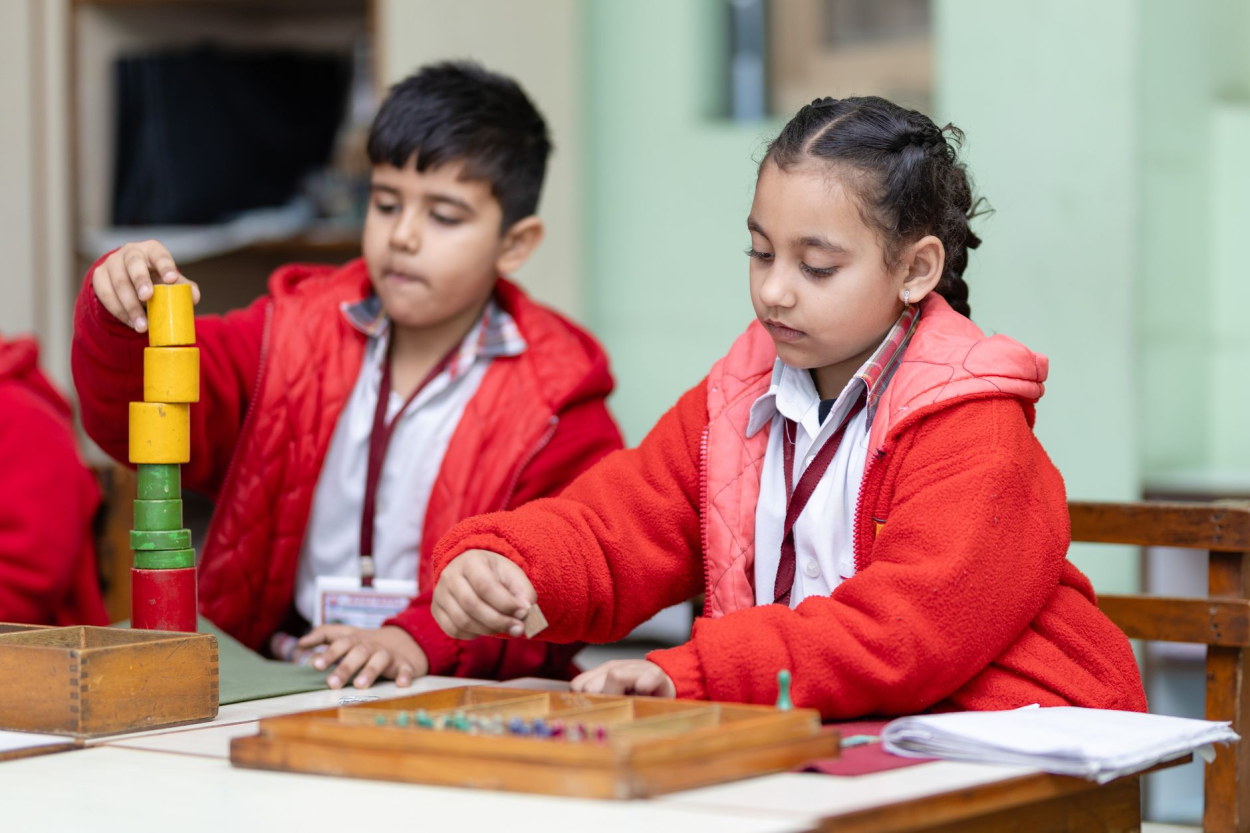
In our experience, children who enter an authentic Montessori setting are usually learning how to make meaningful choices, return materials properly, care for themselves and their environment, and persist with tasks without constant adult prompting. The environment is intentionally structured so children can do more for themselves: pouring water, putting on shoes, preparing a workspace, cleaning up, and selecting work that matches their readiness.
That does not mean children are left to “teach themselves.” A strong Montessori classroom depends on skilled observation, careful presentations, and close knowledge of each child’s developmental needs. What often looks quiet or simple from the outside is actually highly intentional.
Many families are drawn to Montessori because they want their child to build independence, self-regulation, concentration, and confidence through real participation in daily classroom life. If you want to see how environment shapes this experience, our Our Place page gives a sense of the prepared setting we value.
A traditional preschool may feel more familiar to many parents because it often includes group mat times, collaborative art, imaginative play stations, music, stories, and teacher-planned activities built around children’s interests or seasonal themes. In high-quality settings, this can create a rich and socially dynamic atmosphere.
We often see traditional programmes suit children who thrive on frequent social interaction, variety, and shared experiences led by a teacher. These settings can be especially appealing for families who want a broad play-based environment with visible group learning moments and a less structured material sequence.
However, “traditional” does not automatically mean more play-friendly, nor does Montessori automatically mean more academic. In practice, programme quality depends far more on how thoughtfully the environment is prepared, how respectful the adults are, how well children are observed, and whether the curriculum genuinely supports the whole child.
When we help families think this through, we encourage them to focus less on labels and more on day-to-day fit.
That said, children are not fixed types. A shy child may blossom in a Montessori environment because the structure feels safe. A highly independent child may also do beautifully in a strong play-based programme. This is why we recommend observing not only the philosophy on paper, but also how your child responds emotionally to the space, the adults, and the rhythm of the day.
No matter which philosophy a centre describes, we suggest watching for the same core indicators of quality:
We also encourage parents to ask practical questions, such as:
In Aotearoa New Zealand, a useful preschool comparison should not ignore Te Whāriki or the importance of bicultural practice. Te Whāriki describes the early childhood curriculum as holistic, woven through relationships, experiences, and the wider environment, and it places strong emphasis on empowerment, belonging, communication, contribution, and wellbeing. For us, that means the best early learning settings are not simply choosing between “structure” and “play.” They are creating environments where children are respected as capable learners and where family, culture, and identity genuinely matter.
This is one reason we believe families should look beyond superficial descriptions. A centre might use the word Montessori without following authentic Montessori practice. Another might call itself play-based yet still rely heavily on adult-directed routines. We recommend asking how philosophy becomes daily practice, because that is where the real difference shows up.
If your child is likely to thrive in a calm, ordered environment with purposeful hands-on learning, strong support for independence, and opportunities to build deep concentration, Montessori may be the better fit. If your child is likely to flourish in a more socially dynamic setting with frequent group experiences, flexible play zones, and more teacher-led moments across the day, a traditional preschool may feel more natural.
But in our experience, the strongest decision usually comes from visiting, observing, and asking whether the environment feels right for your child now, not whether the philosophy sounds impressive in theory.
If you would like to understand how our team approaches authentic Montessori practice in Miramar, Wellington, you can read more about us or contact us to arrange a conversation.
This article was produced by our internal early childhood education team at Montessori Children’s House. Our editorial process draws on hands-on experience in Montessori preschool practice, daily work with tamariki and whānau, and ongoing review of recognised early childhood curriculum guidance in Aotearoa New Zealand. We write from the perspective of practitioners who think carefully about child development, prepared environments, family partnership, and how educational philosophy translates into real classroom experience.