
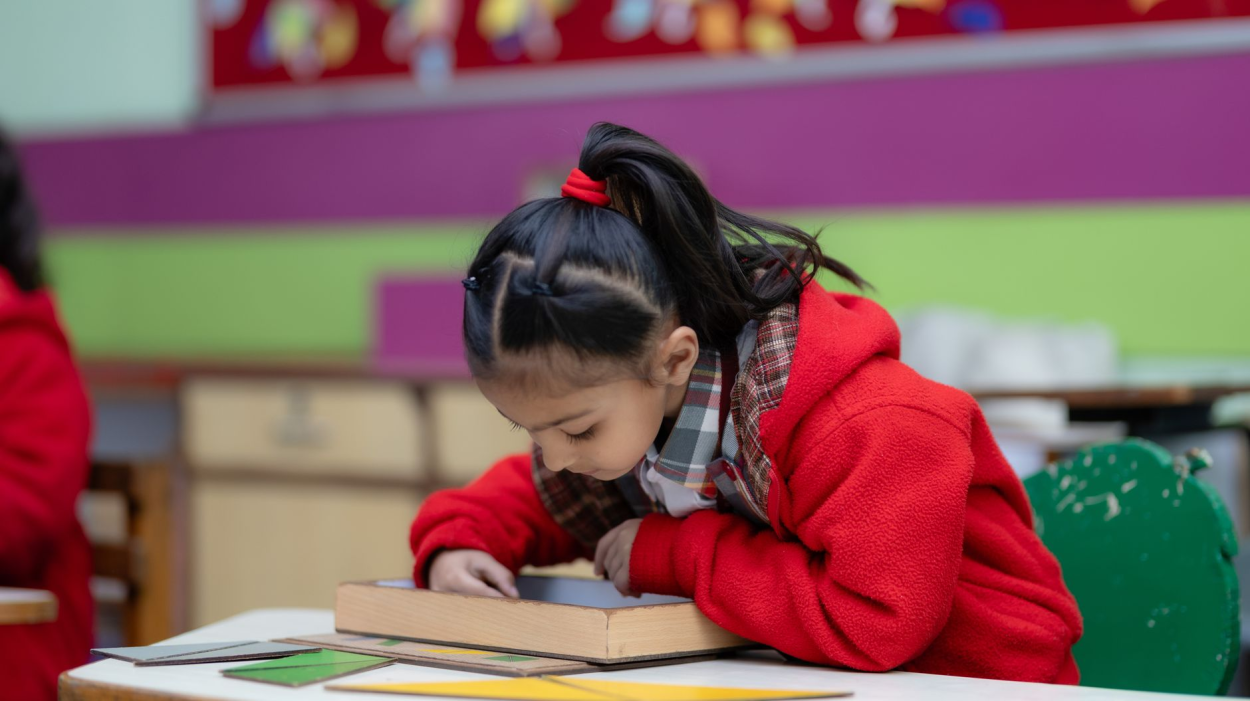
For many families, comparing Montessori with a traditional preschool can feel overwhelming at first. Both approaches can support young children well, but they do so in different ways. In our experience working in early childhood education, the most helpful question is not “Which model is best?” but “Which environment will help our child feel secure, engaged, capable, and ready to learn?”
At Montessori Children’s House, we work from authentic Montessori principles while also supporting children within Aotearoa New Zealand’s early childhood curriculum framework, Te Whāriki. That means we pay close attention not only to independence and concentration, but also to relationships, belonging, communication, contribution, and holistic development. If you are new to Montessori, you may find it useful to start with our overview of Montessori education and learn more about our learning environment.
Montessori education is built around a carefully prepared environment, hands-on learning materials, child choice within clear limits, and mixed-age learning communities. The Montessori approach places strong emphasis on independence, order, concentration, movement, and self-directed learning. In authentic Montessori settings, children are supported to choose purposeful work, repeat activities, and develop confidence through doing things for themselves.
A traditional preschool, by contrast, often uses a teacher-planned group structure with more whole-group activities, shared transitions, and a broader mix of guided play, free play, craft activities, story time, music, and early learning experiences. Many traditional centres are highly nurturing and play-based, and in New Zealand they are commonly shaped by Te Whāriki’s broad, holistic curriculum framework.
Neither model is automatically better in every case. We often see children thrive when the setting matches how they learn best, how they handle routine and change, and what kind of support helps them feel settled and confident.
| Area | Montessori preschool | Traditional preschool |
|---|---|---|
| Classroom structure | Prepared environment with defined learning areas and sequenced materials | Usually more flexible room setup with varied play stations and group areas |
| Child choice | High level of choice within clear boundaries | Often a mix of free play and teacher-led activities |
| Teacher role | Guide who observes closely and introduces materials intentionally | Teacher often leads group routines, activities, and transitions more directly |
| Learning format | Mostly individual or small-group, hands-on work | Often includes more whole-group learning and collaborative activities |
| Age grouping | Typically mixed-age classrooms | Often same-age or closer age-band groupings |
| Pace of learning | Children often progress at their own pace | Pace may be more shaped by group routines and shared activities |
| Typical strengths | Independence, concentration, self-management, practical life skills | Group participation, flexibility, social navigation, teacher-guided variety |
In Montessori, a child may spend a meaningful stretch of time choosing work, carrying materials independently, completing an activity from beginning to end, returning it to its place, and then selecting the next task. That uninterrupted cycle matters. We typically see children build focus, coordination, persistence, and a genuine sense of capability when they are trusted with real responsibility and enough time to become absorbed in what they are doing.
In a traditional preschool, the day may include a wider rhythm of teacher-led mat times, art or sensory experiences, outdoor play, dramatic play, music, stories, and small-group activities. For some children, this variety feels energising and socially rich. For others, especially those who like predictability and deep engagement, a busier group format can sometimes feel overstimulating.
It is also important to remember that these labels cover a wide range of real classrooms. Some traditional preschools are calm, highly child-centred, and beautifully responsive. Some Montessori settings are more authentic than others. We always encourage families to look beyond the label and examine what actually happens in the room each day.
One reason Montessori fits well within the New Zealand context is that many of its strengths complement the principles and strands of Te Whāriki. Te Whāriki emphasises empowerment, holistic development, family and community, and relationships, alongside the strands of wellbeing, belonging, contribution, communication, and exploration. In practice, we see strong overlap when children are respected as capable learners, supported in meaningful relationships, and given opportunities to participate actively in their environment.
For example, practical life activities in Montessori can support confidence, contribution, and self-care. Mixed-age settings can create natural opportunities for younger children to observe and for older children to model, help, and lead. Carefully prepared materials can encourage exploration and communication through concrete experience rather than passive instruction alone.
At the same time, traditional preschool settings may offer strengths of their own, especially for children who enjoy frequent collaborative play, imaginative group experiences, and teacher-guided social interaction. The right fit depends on the whole child, not a single feature of the programme.
In our experience, Montessori can be an especially good fit for children who:
That said, Montessori is not only for naturally quiet or highly focused children. We often see active children thrive as well, especially when movement is treated as part of learning rather than something separate from it. Practical, sensory, and hands-on work can be very regulating for children who need meaningful physical engagement.
A traditional preschool may suit children who:
We also see some families choose a traditional setting because they want a familiar preschool format that feels closer to what they experienced themselves. That can be a perfectly reasonable consideration, especially if the centre is warm, responsive, and aligned with your family’s values.
When families are deciding between approaches, we usually suggest spending less time on marketing language and more time observing the child experience. During a visit, ask questions like:
We also encourage families to watch the children, not just the adults. Are the children calm, engaged, and purposeful? Do they seem secure in the space? Are teachers responsive without over-directing? Does the environment invite participation? Those observations usually tell us more than a brochure does.
Authentic Montessori is structured, but it is not rigid in the way many people assume. The structure exists to support freedom, not replace it. Children are given meaningful choice within a carefully prepared environment, rather than unlimited choice in a chaotic one.
High-quality traditional early childhood programmes are usually far more intentional than that. Strong teaching, observation, relationship-based practice, and curriculum planning can all sit within a play-based framework.
This is another common misunderstanding. Montessori classrooms are social environments, just social in a different way. Instead of constant whole-group interaction, children often build social capability through mixed-age relationships, shared responsibility, observation, turn-taking, and purposeful collaboration.
If your child seems to flourish with order, independence, purposeful activity, and time to concentrate, Montessori may be an excellent fit. If your child lights up in highly social, fast-moving, teacher-led group experiences, a more traditional preschool may suit them better. In either case, the best setting is one where your child feels safe, known, respected, and genuinely engaged in learning.
We recommend visiting in person, asking detailed questions, and imagining your child in the daily rhythm of the classroom rather than choosing based on educational labels alone. If you are exploring whether an authentic Montessori environment may be right for your family, you can learn more about our approach or contact us to arrange a conversation.
This article was produced by our internal early childhood education team at Montessori Children’s House. Our editorial approach draws on day-to-day experience in Montessori practice, child development observation, curriculum planning, family communication, and the practical realities of supporting young children in an Aotearoa New Zealand early learning setting. We write from the perspective of practitioners who work closely with children and whānau, and we review each topic for clarity, accuracy, and real-world usefulness.