At our centre, we do not see Te Whāriki and Montessori as competing approaches. We see them as complementary. Te Whāriki is the curriculum framework that guides early childhood education across Aotearoa New Zealand, and Montessori gives us a clear, purposeful way to prepare the environment, observe each child, and support independence, concentration, and respectful relationships.
In practice, this means our Montessori environment is not separate from Te Whāriki. Rather, it is one way of bringing Te Whāriki to life. The national curriculum asks kaiako to support children as competent and confident learners, while recognising their language, culture, identity, and relationships. In our experience, authentic Montessori practice works best when it is deeply connected to those same outcomes.
Families who are exploring our approach can learn more about Montessori, our learning environment at Our Place, and our philosophy on the About page.
Te Whāriki matters because it is the foundation for early learning in New Zealand. It provides a woven framework rather than a prescriptive checklist. That matters in Montessori settings because Montessori is also built on thoughtful observation, responsiveness, and respect for developmental timing. We do not teach every child in the same way at the same moment. Instead, we prepare conditions for learning and respond to each child’s readiness, interests, and need for challenge.
What Te Whāriki adds is a distinctly Aotearoa lens. It places strong emphasis on bicultural practice, relationships, whānau voice, belonging, and the wider social and cultural context of learning. In our view, this strengthens Montessori practice. It reminds us that independence is never isolated from community, and that individual development happens within relationships, culture, place, and identity.
When we look closely, the alignment is strong. Montessori offers a prepared environment, mixed-age learning, uninterrupted work cycles, hands-on materials, and careful observation by trained adults. Te Whāriki brings a holistic curriculum framework organised around principles and strands that honour the whole child.
We often explain it this way to families: Montessori gives us the structure of the learning environment, while Te Whāriki helps ensure that the child’s learning is understood in a broader, relational, and cultural context.
Some of the clearest areas of alignment include:
Holistic development: Montessori supports cognitive, physical, social, emotional, and practical development together rather than as isolated subjects.
Child agency: Both approaches value children as capable learners who actively participate in their own development.
Relationships: Montessori classrooms rely on respectful interactions, peer learning, and calm adult guidance. Te Whāriki similarly centres responsive and reciprocal relationships.
Observation-based teaching: In both approaches, adults watch carefully, interpret meaning, and make intentional decisions about what support, space, or challenge is needed next.
Belonging and contribution: Mixed-age Montessori communities naturally create opportunities for leadership, care, grace and courtesy, and participation in collective life.
One of the most useful ways to understand the relationship between Te Whāriki and Montessori is to look at the five strands and ask what they look like in a real early learning environment.
In our Montessori environment, wellbeing starts with predictability, emotional safety, and respect. Children know where things belong, how to move through the space, and what is expected. Practical life activities help children develop self-care, self-regulation, coordination, and confidence. Just as importantly, calm and consistent adults help children feel secure.
We typically see children flourish when the environment is ordered, the routines are steady, and they are trusted to do meaningful things for themselves.
Belonging is more than attendance. It is the feeling that this is my place, these are my people, and I matter here. Montessori supports this through a carefully prepared environment where children can orient themselves, act with purpose, and participate in the life of the community. Te Whāriki asks us to go further by recognising whakapapa, whānau, place, language, and culture as central to belonging.
In practice, we work to create continuity between home and centre, to welcome family voice, and to ensure each child’s identity is seen and respected.
Montessori communities are built for contribution. Children help set tables, care for plants, tidy materials, support younger peers, and participate in everyday routines. These are not small tasks to keep children busy. They are part of how children learn competence, responsibility, and social awareness.
Te Whāriki reinforces the importance of equitable opportunities to learn and contribute. In our experience, contribution grows when children are given real responsibility in a community that expects them to be capable.
Communication in Montessori includes rich oral language, precise vocabulary, storytelling, songs, conversation, listening, and early symbolic understanding through concrete materials. Te Whāriki broadens the frame by emphasising the many ways children communicate, including movement, gesture, creative expression, home languages, and cultural forms of meaning-making.
This matters because communication is not only about literacy readiness. It is also about identity, connection, confidence, and being understood.
Exploration is central to Montessori. The materials invite repetition, experimentation, sensory refinement, classification, sequencing, problem-solving, and discovery. Children learn by doing. Te Whāriki aligns closely with this, recognising active exploration of the environment as essential to learning.
Where we find the combination especially powerful is that Montessori gives concrete pathways for exploration, while Te Whāriki keeps us attentive to curiosity in its wider forms, including imaginative, cultural, social, and environmental exploration.
This is one of the most important areas where Montessori centres in Aotearoa need to be intentional. Montessori on its own does not automatically guarantee strong bicultural practice. That work requires reflection, commitment, and relationship. Te Whāriki makes this visible and non-optional.
For us, this means we need to think carefully about how Te Tiriti o Waitangi, te ao Māori, whānau aspirations, and local context are genuinely reflected in daily life rather than added as surface elements. It affects how we build relationships, how we speak about identity and belonging, what stories and language are present, how we design routines, and how we understand children in connection with whānau and community.
We also find that whānau partnership is stronger when families understand that Montessori is not just about materials or independence. It is about forming respectful, capable human beings in relationship with others. Te Whāriki helps keep that wider purpose in view.
We do not find that to be true when Montessori is practiced authentically. Yes, children work independently, but they do so within a social community. Grace and courtesy, shared responsibility, peer modelling, and care for the environment are all communal practices. Independence in Montessori is not isolation. It is participation with growing competence.
In our experience, the opposite is more accurate. A strong Montessori programme in New Zealand should be able to clearly show how its practice reflects Te Whāriki. The curriculum is flexible enough to be enacted through different pedagogical approaches, including Montessori, as long as the principles, strands, and outcomes are meaningfully supported.
A well-prepared Montessori environment is structured, but it is not rigid. The structure exists to support freedom with responsibility. Many children benefit from knowing where materials are, how to use them, and what respectful participation looks like. Within that structure, there is considerable room for choice, repetition, movement, and self-directed learning.
| Te Whāriki area | What it emphasises | How we see it in Montessori practice |
|---|---|---|
| Wellbeing | Emotional and physical safety, self-regulation, health, confidence | Orderly routines, practical life, respectful guidance, calm spaces, growing independence |
| Belonging | Connection to place, people, identity, and community | Prepared environment, consistent routines, mixed-age community, family connection, cultural responsiveness |
| Contribution | Participation, responsibility, fairness, collaboration | Care of self and environment, peer support, shared routines, meaningful work |
| Communication | Language, expression, listening, symbols, culture | Rich vocabulary, conversation, stories, songs, hands-on pre-literacy materials, multiple forms of expression |
| Exploration | Curiosity, inquiry, play, experimentation, discovery | Sensory materials, practical investigation, repetition, problem-solving, child-led discovery |
If you are choosing an early learning environment for your child, we encourage you to look beyond labels and ask how the curriculum works in everyday practice. A strong Montessori setting in Aotearoa should be able to explain not only its Montessori philosophy, but also how that philosophy supports the aims of Te Whāriki.
Ask how children’s wellbeing and belonging are supported when they first join the centre.
Ask how whānau aspirations are listened to and reflected in planning and communication.
Ask how bicultural practice is embedded in daily life, not just celebrated occasionally.
Ask how independence is balanced with empathy, contribution, and community responsibility.
Ask how kaiako observe children and use those observations to guide learning.
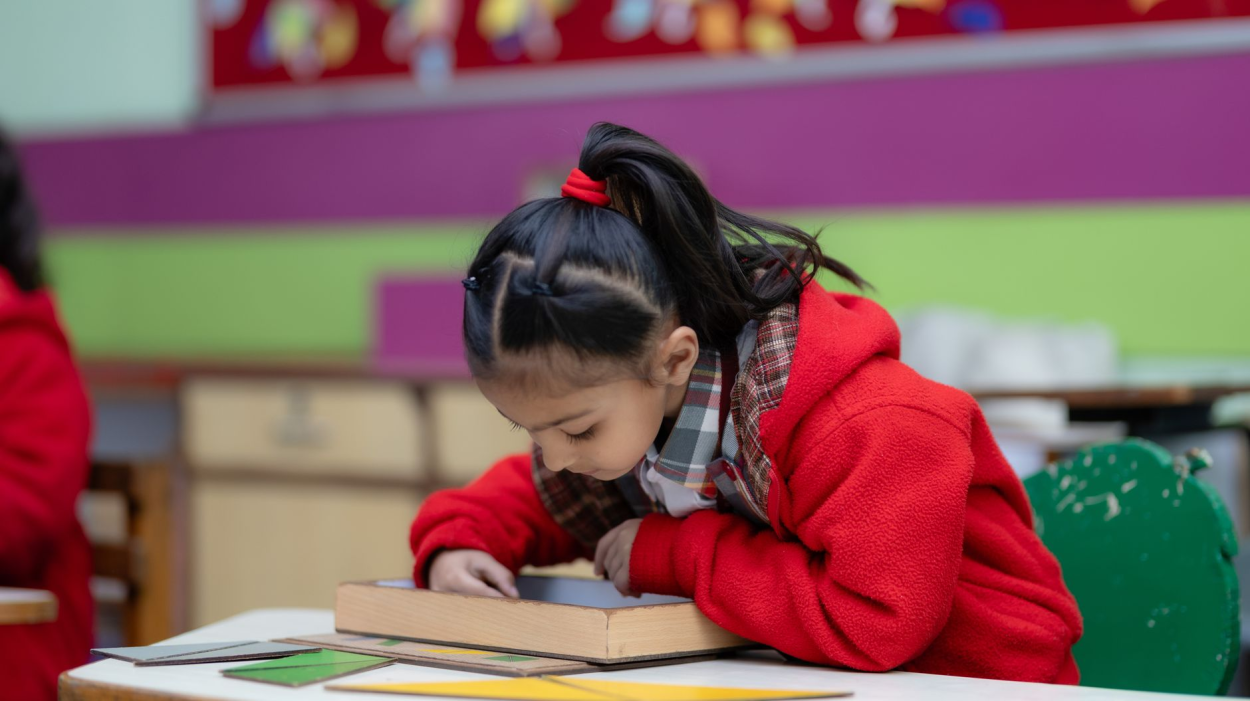
When families visit us, we want them to see a living environment rather than a theoretical model: children concentrating, helping one another, caring for their space, communicating with confidence, and building capability step by step. If you would like to talk with our team about what this looks like in practice, you are welcome to contact us.
This article was produced by our internal early childhood education team at Montessori Children's House. Our editorial approach draws on day-to-day experience in Montessori practice, curriculum interpretation, whānau communication, and the realities of supporting young children in an Aotearoa early learning context. We write from the perspective of practitioners who work with Montessori principles alongside Te Whāriki, with a focus on practical application, respectful relationships, and trustworthy guidance for families.