
When families first compare early childhood options, we often hear the same question: is Montessori simply another form of daycare, or is it something fundamentally different? In our experience, that question matters because the answer shapes what a child does each day, how independence develops, and how learning is supported over time.
Authentic Montessori education is not just childcare provided in a pleasant setting. It is a carefully prepared educational approach grounded in Dr. Maria Montessori’s principles, delivered through purposeful materials, observation-based teaching, mixed-age learning, and long periods of uninterrupted concentration. At the same time, in Aotearoa New Zealand, quality early childhood programmes also operate within the national curriculum framework of Te Whāriki and the wider expectations of early learning services.
At our centre, we see the strongest outcomes when families understand that authentic Montessori is both nurturing and academically purposeful. Children are cared for, but they are also trusted with meaningful work, real responsibility, and an environment designed for growing capability. If you are exploring Montessori education for your child, it helps to know what makes it distinct from a standard daycare model.
Authentic Montessori education is a child-centred approach in which children learn through active engagement with a prepared environment rather than through constant adult direction. In practice, that means we organise the classroom so children can choose purposeful activities, repeat them, care for their space, develop concentration, and progress at their own pace with guidance from trained adults.
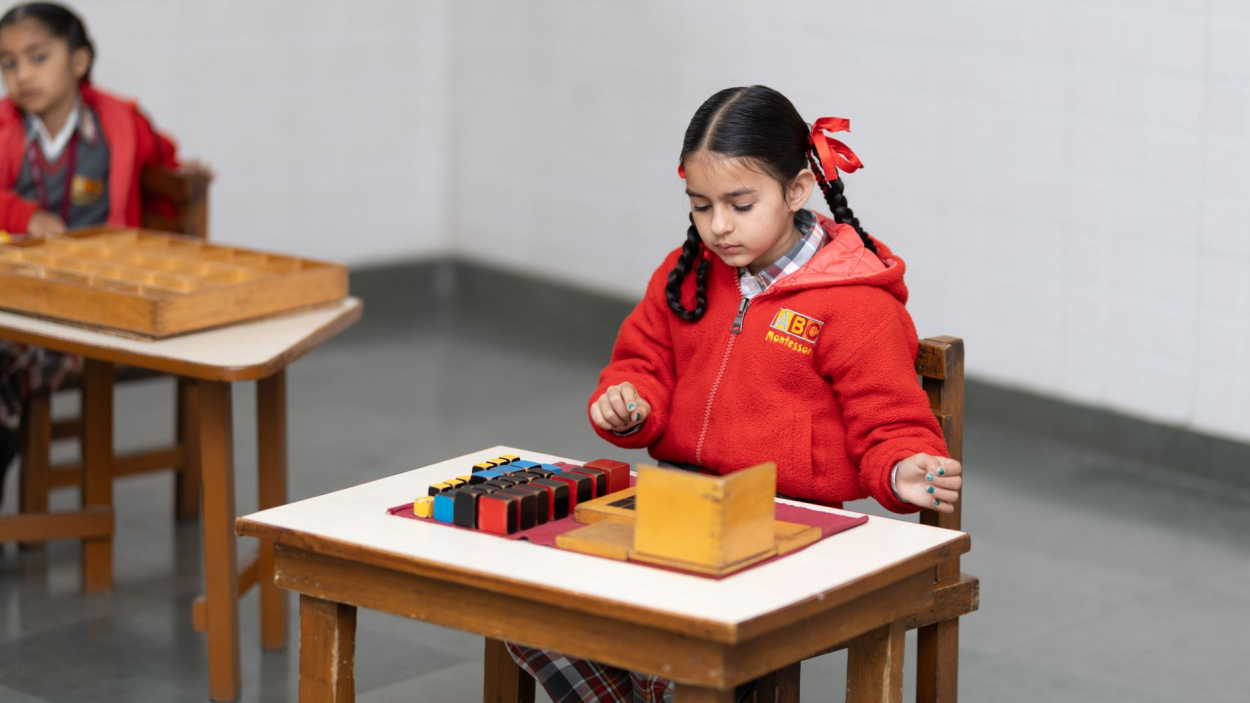
In an authentic Montessori setting, the environment is not random. Materials are sequenced. Shelves are ordered. Furniture is child-sized. Activities are introduced carefully. Children are shown how to use materials independently and how to return them for the next person. This structure matters because freedom in Montessori is not the same as doing anything at any time. It is freedom within clear limits.
We also see that authenticity depends on more than appearance. A centre may use natural wood furniture or call itself Montessori, but that alone does not make the programme authentic. Core features usually include Montessori-trained teachers, mixed-age groupings, child-directed work, specially designed hands-on materials, and uninterrupted work periods long enough for concentration to deepen.
Within New Zealand early childhood education, this work sits alongside Te Whāriki, which guides all early learning services and places emphasis on empowerment, holistic development, family and community, and responsive relationships. In our view, an authentic Montessori programme in Aotearoa should not feel disconnected from that context. It should honour the child’s independence while also supporting belonging, relationships, identity, culture, and whānau partnership.
Daycare and Montessori can both provide safe care, warm relationships, and social opportunities. The main difference is that authentic Montessori is designed first as an educational method with a distinctive philosophy, environment, and teaching practice, rather than primarily as supervised care for children while parents work.
| Area | Authentic Montessori Education | Typical Daycare Model |
|---|---|---|
| Primary focus | Purposeful early education through independence, concentration, and self-directed learning | Care, routines, play, and general group activities |
| Classroom design | Prepared environment with sequenced, child-accessible materials | Shared play environment with broader activity zones and toys |
| Role of teacher | Observer, guide, and careful presenter of lessons | Supervisor, caregiver, and activity leader |
| Grouping | Usually mixed-age, allowing peer modelling and leadership | More commonly grouped by narrow age band |
| Child choice | High, within structured limits and purposeful work options | Varies, often shaped by group schedule |
| Learning materials | Specialised Montessori materials with a developmental sequence | General toys, crafts, and open-ended resources |
| Work cycle | Long uninterrupted periods for deep engagement | More frequent transitions between activities |
| Independence | Explicitly taught through daily routines and practical life work | Supported, but not always central to programme design |
In our experience, the most visible difference is the pace of the day. In many daycare settings, the rhythm is adult-led, with regular transitions from one group activity to the next. In Montessori, we protect blocks of uninterrupted time because concentration is treated as a developmental achievement, not as an accidental by-product.
Another major difference is the role of practical life. In authentic Montessori classrooms, young children are not only playing; they are pouring, sorting, cleaning, carrying, preparing food, caring for plants, rolling mats, greeting others respectfully, and learning to manage themselves within a community. These activities may look simple, but they build coordination, order, confidence, responsibility, and attention.
We also find that families notice a difference in how adults interact with children. Instead of stepping in immediately, Montessori teachers observe first, then guide with precision. We try to help children do as much as they can for themselves, because independence is not an extra feature in Montessori; it is one of the central aims.
For parents visiting centres, authenticity can be difficult to judge at first glance. Beautiful spaces can still be educationally inconsistent, and some programmes use Montessori language quite loosely. We usually suggest looking beyond branding and asking how the classroom actually works from morning to afternoon.
Here are some practical signs we believe matter:
Parents can also pay attention to whether children seem deeply engaged rather than constantly entertained. In authentic Montessori classrooms, we expect to see purposeful movement, individual choice, repetition, and a sense of calm productivity. It may look quieter than daycare, but it is often more active in terms of internal learning.
If you would like to understand how the physical environment supports this approach, our prepared setting and learning spaces show how order, accessibility, and beauty contribute to children’s independence and concentration.
The distinction between authentic Montessori and daycare is not about ranking one model as universally better for every family. It is about fit. Families should know whether they are choosing primarily a care model, a structured educational philosophy, or a programme that blends both.
In our experience, authentic Montessori particularly benefits children who thrive when adults respect their capability, maintain predictable routines, and offer meaningful independence. It can be especially powerful during the early years because this is when habits of attention, order, movement, language, and self-care are forming so quickly.
We also see long-term value in mixed-age learning. Younger children absorb social and practical cues from older peers. Older children strengthen confidence by helping, modelling, and taking responsibility within the classroom community. This is different from keeping children only with same-age peers for most of the day.
Another important point for New Zealand families is that early childhood education is not separate from wider developmental goals. Te Whāriki emphasises that children learn through relationships, play, belonging, communication, and exploration. A strong Montessori programme can support these outcomes in a distinctive way: through prepared freedom, hands-on activity, and a community built around respect and purposeful work.
When families talk with us, we encourage them to ask direct questions rather than relying only on labels. A thoughtful centre should be able to explain not just what it offers, but why it is set up that way.
These questions usually reveal the difference between a centre that uses Montessori ideas occasionally and one that builds its daily practice around them.
If you are comparing options for your child, we welcome families to get in touch with our team and ask exactly these kinds of questions. We believe parents should feel clear about what they are choosing and why it matters.
If you remember only one thing, let it be this: authentic Montessori is not defined by the name alone. It is defined by how children learn each day.
We suggest looking for a programme where children are trusted to act independently, where the environment is intentionally prepared, where teachers are guides rather than constant directors, and where concentration is protected through uninterrupted work time. If a setting focuses mainly on supervision, convenience, and general group activity, it may be a good daycare, but it is not necessarily authentic Montessori.
For many families, the best next step is to observe a classroom in action. Watch the children. Notice the pace. See whether the room is organised for independence. Listen to how adults speak. Those details usually tell you more than any brochure can.
This article was produced by our internal Montessori Children's House editorial team in consultation with our early childhood education practitioners. We write from the perspective of a team working within authentic Montessori practice in Miramar, Wellington, with day-to-day experience supporting young children, communicating with whānau, and aligning Montessori principles with Te Whāriki and the wider expectations of early childhood education in Aotearoa New Zealand. Our process combines practical classroom understanding with careful review of authoritative public guidance so families receive advice that is clear, grounded, and trustworthy.