
When families first ask us what Montessori education is, they are often really asking a deeper question: what will learning feel like for my child each day? In our experience, Montessori works best when parents understand that it is both a philosophy and a practical classroom approach. It is designed to help children become capable, confident, independent learners through purposeful activity, careful observation, and a respectful learning environment.
At Montessori Children's House, we see Montessori preschool as much more than childcare. It is an approach to early childhood education that helps tamariki build concentration, coordination, self-confidence, social awareness, and everyday life skills at a pace that matches their development. If you are new to the approach, our Montessori page offers a helpful starting point, and our Our Place page shows how environment supports learning in practice.
Montessori education began with Dr Maria Montessori and has grown into a widely recognised child-centred approach used around the world. In early childhood settings, the core idea is simple: children learn best when they can actively engage with meaningful work in an environment prepared for independence, movement, order, and discovery.
Rather than relying on constant whole-group instruction, we prepare spaces where children can choose purposeful activities, repeat them, develop mastery, and receive guidance when they are ready for the next step. This helps learning become active instead of passive. It also supports the child as a whole, not only academically, but socially, emotionally, physically, and culturally.
In a Montessori preschool, children are not expected to all move at the same speed. We typically see stronger engagement when children are allowed to work according to their readiness. Some may spend time pouring, sorting, and caring for their environment. Others may be building early mathematical understanding, refining language, or working with sensorial materials. All of this is real learning.
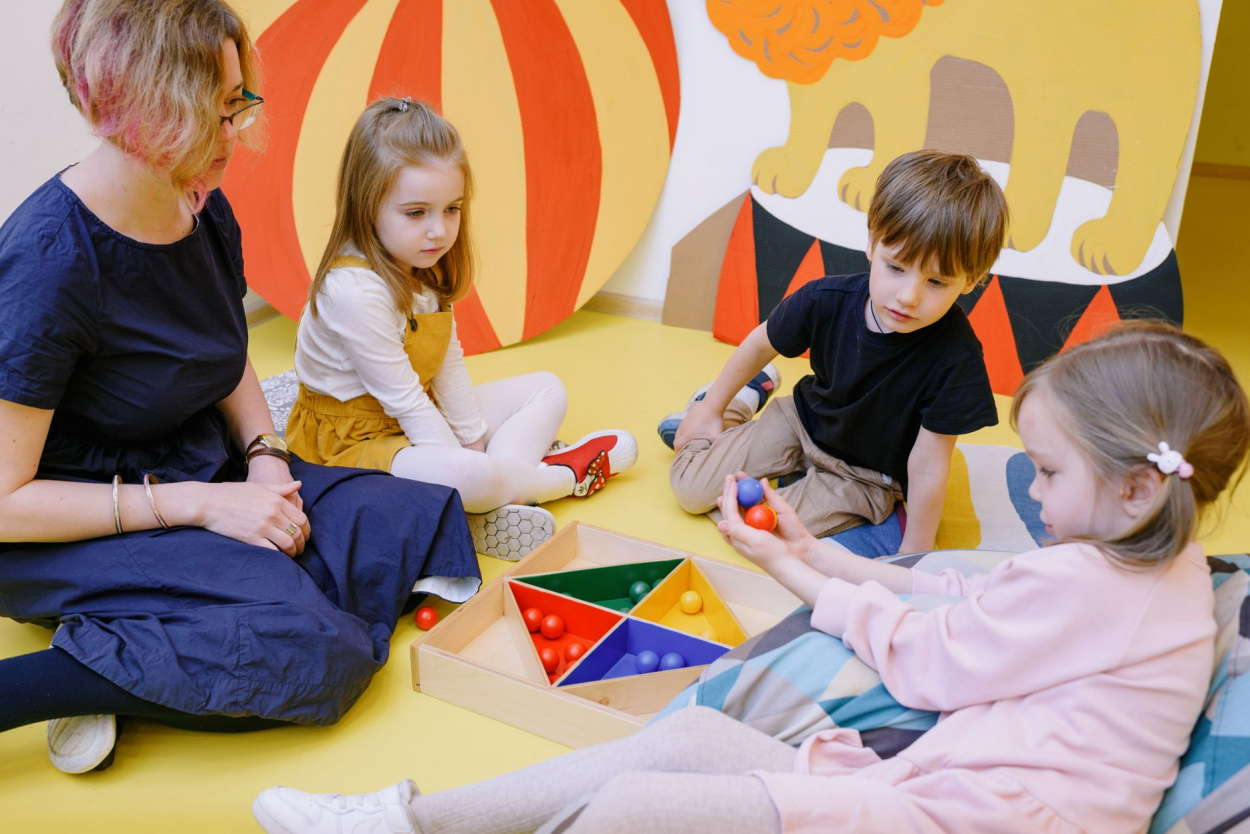
In our experience, Montessori becomes easiest to understand when families picture what happens during an ordinary morning. Children enter a calm, orderly environment. Materials are displayed accessibly on low shelves. Each activity has a clear purpose and a defined place. The child chooses work, carries it carefully, uses it with concentration, and returns it when finished.
This process may look simple, but it develops several foundational abilities at once: decision-making, coordination, responsibility, persistence, and self-regulation. Over time, children learn how to manage themselves within a shared community.
A Montessori preschool typically includes long, uninterrupted work periods. We find these blocks of time are important because young children often need a chance to settle, repeat, correct mistakes, and deepen concentration without being rushed from one task to the next. The goal is not to keep children busy. The goal is to support meaningful engagement.
Mixed-age grouping is another defining feature. In the preschool years, this often means children aged around 3 to 6 learning in the same environment. Younger children learn by observing older peers, while older children strengthen confidence and leadership by modelling routines and helping care for the community.
The classroom is intentionally arranged to support independence. Children should be able to reach materials, move safely, make choices, and participate in caring for their surroundings. Order matters because it helps children feel secure and understand expectations.
Montessori materials are designed so children can learn through direct experience. Instead of only being told a concept, they explore it physically. This is especially powerful in the preschool years, when learning is deeply connected to movement and the senses.
Montessori is sometimes misunderstood as unstructured, but that is not what we see in authentic practice. Children have freedom to choose purposeful work within a carefully prepared framework. The limits are clear, consistent, and respectful: use materials appropriately, care for the environment, and respect others.
Children benefit from being part of a community rather than a narrow age band. This structure supports observation, peer learning, patience, and empathy.
Many Montessori activities are designed around the principle of helping the child do things for themselves. Practical life experiences such as pouring, dressing, cleaning, food preparation, and tidying are not extras. They are central to building confidence and capability.
One of the most common misconceptions we hear is that Montessori is only about independence or life skills. In reality, a Montessori preschool environment supports a broad foundation for learning.
Children typically engage across areas such as practical life, sensorial exploration, early language, early mathematics, cultural learning, art, music, movement, and social development. The difference is in how these areas are approached. Instead of separating learning into artificial blocks, Montessori weaves them through meaningful activity.
For example, when a child carries a tray, pours water, wipes a spill, and returns the materials neatly, they are developing coordination, concentration, sequencing, and responsibility. When a child works with sound games, classified language cards, counting materials, or patterning activities, they are building early literacy and numeracy foundations in concrete, developmentally appropriate ways.
We also see that Montessori learning helps children develop habits that matter long after preschool: staying with a task, noticing detail, solving small problems independently, respecting shared spaces, and taking pride in completing real work.
In Montessori, the adult's role is active, but it is different from a constantly directing teaching style. Our kaiako prepare the environment, observe carefully, introduce materials individually or in small groups, protect concentration, and connect each child with work that supports their next stage of development.
This means the teacher is not passive. In fact, Montessori teaching requires close attention, thoughtful timing, and a strong understanding of child development. We often explain it this way: instead of doing the learning for the child, we create the conditions in which the child can do meaningful learning for themselves.
Respect is central to this relationship. Children are guided with warmth, consistency, and high expectations for capability. We find that when adults slow down, observe more, and intervene thoughtfully, children often show us they can do far more than we first assumed.
In Aotearoa New Zealand, Montessori preschool does not sit outside the broader early childhood context. It works alongside national curriculum expectations and the values that shape early learning here. Te Whāriki describes early childhood learning as interconnected and holistic, supporting children to grow as confident and competent learners. That is very compatible with how we understand Montessori in practice.
Our approach is also strengthened by the context of place, culture, relationships, and community. For us, authentic Montessori practice in New Zealand includes thoughtful engagement with Te Whāriki, respect for the Treaty of Waitangi, and a commitment to seeing each child within their family and whānau context.
Families who want to understand more about our values and approach can also explore our About page.
In our experience, it is neither extreme. Montessori offers freedom within structure. Children choose from purposeful activities in an environment shaped by clear expectations, routines, and respectful boundaries.
Yes. Montessori preschool supports strong foundations in language and mathematics through hands-on, concrete materials and repeated practice. The progression is intentional, even if it looks different from worksheet-based learning.
Montessori often works well for active children because movement is built into the learning process. Children carry materials, walk purposefully, care for the environment, and use their hands throughout the day.
We usually recommend looking closely at the environment, the calmness of the classroom, the independence children show, the role of the kaiako, and how respectfully children are treated. If you would like to speak with us directly, our Contact page is the best next step.
| Area | How Montessori works | Why it matters |
|---|---|---|
| Learning approach | Children choose purposeful work from a prepared environment | Builds independence, motivation, and ownership of learning |
| Classroom structure | Mixed-age preschool community, typically 3 to 6 years | Supports peer learning, leadership, and social development |
| Materials | Hands-on resources with clear learning purpose | Helps children understand concepts through direct experience |
| Teacher role | Kaiako observe, guide, and introduce work thoughtfully | Matches learning to developmental readiness |
| Daily rhythm | Uninterrupted work periods and consistent routines | Strengthens concentration and persistence |
| Practical life | Real tasks such as pouring, dressing, cleaning, and food preparation | Develops coordination, confidence, and responsibility |
| Curriculum fit | Holistic learning aligned with early childhood development | Supports the whole child across multiple learning areas |
If you are exploring Montessori for your preschool child, we suggest focusing on a few practical questions.
In our experience, the best Montessori environments are not defined by branding alone. They are defined by what children are actually able to do, how adults interact with them, and how consistently the environment supports concentration, dignity, and meaningful growth.
This article was produced by our internal editorial and education team at Montessori Children's House. We write from the perspective of practitioners working in early childhood education and childcare, informed by day-to-day experience in Montessori preschool environments, ongoing curriculum reflection, and close engagement with families in our local community. Our process combines operational knowledge, sector-specific research, and practical understanding of how Montessori principles are applied in real early learning settings in Aotearoa New Zealand.