In early childhood education, the age range in a classroom is not just an administrative detail. It shapes how children relate to one another, how they learn, and how they develop confidence over time. In our experience, mixed-age classrooms create a richer learning community because children are not all expected to be at the same stage, at the same pace, on the same day.
At Montessori Children's House's Montessori programme, we see mixed-age learning as far more than a classroom arrangement. It is part of an intentional educational design. Younger children learn through watching and absorbing. Older children strengthen their confidence and understanding through repetition, responsibility, and modelling. The result is often a calmer, more collaborative environment than many families expect when they first hear the term.
For families exploring authentic early childhood education, understanding why mixed-age classrooms matter can make it much easier to recognise what meaningful child-led learning looks like in practice.
A mixed-age classroom brings children of different ages together in the same prepared learning environment rather than separating them into narrow year-based groups. In Montessori early childhood settings, this is a core feature of the approach, not an optional extra.
In practical terms, that means children can learn within a community where there are beginners, developing learners, and more experienced learners all sharing the space. We often explain it to families as being closer to real life: most homes, whānau settings, and communities are naturally mixed in age, ability, interests, and confidence.
This matters because early development is uneven by nature. A child may be highly capable in language, still developing social confidence, and only beginning to refine fine motor skills. Mixed-age environments make room for that natural variation more effectively than rigid age grouping.
Mixed-age classrooms are one of the recognised hallmarks of Montessori education. Montessori organisations describe multi-age grouping as a core component because it supports observation, peer learning, independence, and a sense of classroom community.
In our day-to-day practice, the real value is that children are not constantly compared against a single age-based benchmark in front of peers. Instead, they are invited to work toward readiness, concentration, coordination, and self-direction in a more natural way. That shift changes the emotional tone of the classroom.
We typically see several patterns emerge over time:
That continuity is especially important in early childhood, where emotional safety and predictable routines strongly influence a child’s willingness to engage, explore, and persist.
One of the clearest benefits of mixed-age education is social learning. Younger children can observe how to carry materials, wait their turn, join a group respectfully, tidy a workspace, and ask for help. Older children learn that leadership is not about control; it is about contribution, responsibility, and care for others.
In our experience, this can reduce some of the friction that appears in same-age groups where many children are competing for the same role, the same level of attention, or the same developmental territory.
Children build confidence in different ways at different stages. In a mixed-age environment, a younger child can feel inspired rather than pressured by seeing what is possible. An older child can feel capable because they are no longer always among the youngest or least experienced.
We often see children grow in confidence when they realise they can both receive support and offer it. That balance matters. It helps children experience themselves as active members of a learning community, not just recipients of adult direction.
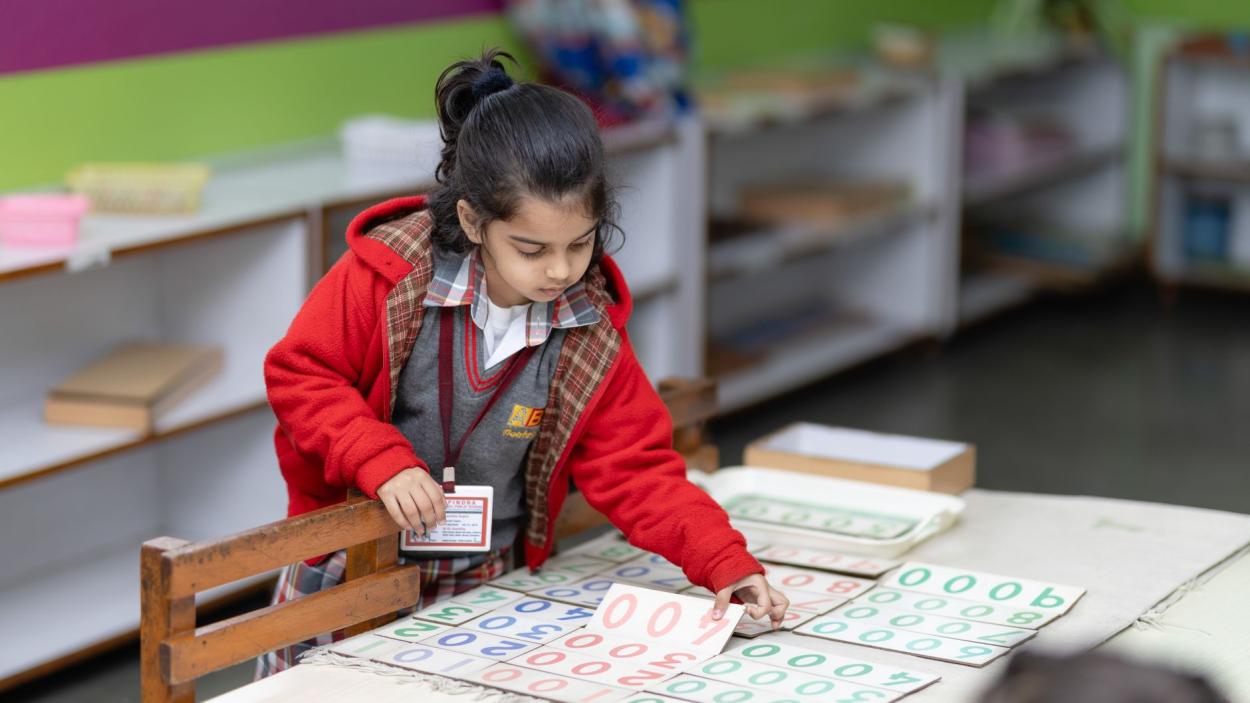
Observation is central in early childhood learning, especially in Montessori environments. Children take in language, movement, order, grace, courtesy, and work habits long before they can fully explain what they are learning.
Mixed-age classrooms make this process more powerful because there are more models available. A child does not only learn from the adult. They also learn from the peer who rolls a mat carefully, the older child who completes a sequence independently, or the younger child who approaches a task with curiosity and persistence.
We often remind families that readiness does not arrive on a birthday. Some children need more repetition. Others are ready for complexity earlier. A mixed-age class helps us respond to the child in front of us rather than to an arbitrary assumption about what every child of one age should be doing.
This fits closely with authentic Montessori practice, where the environment is designed to support self-paced development within a carefully prepared structure. It also aligns with what many educators recognise more broadly: development is dynamic, not perfectly linear.
When children remain in a mixed-age setting across more than one year, they experience the classroom from different perspectives. First they enter as newcomers, then they become experienced members of the community. That progression matters. It supports belonging, responsibility, and emotional maturity.
For many children, the third year in an early childhood Montessori environment is especially significant because they are able to consolidate learning, demonstrate independence, and contribute more visibly to the classroom culture.
As an early childhood education team in Aotearoa New Zealand, we do not view Montessori in isolation from the wider curriculum context. We understand mixed-age learning as highly compatible with Te Whāriki because both place strong value on the child as a competent and confident learner within relationships, environment, and community.
In practice, mixed-age classrooms can support several important curriculum themes by helping children experience belonging, contribution, communication, exploration, and wellbeing in everyday routines. Children are not only completing activities. They are learning how to participate in a shared environment with others whose needs and abilities may differ from their own.
We also find that mixed-age communities can support respectful, relational learning in ways that sit well with whānau-centred early childhood practice. Children are given opportunities to observe, collaborate, care, and take increasing responsibility within a collective setting.
Families who want to understand how our environment is set up can learn more about our place and learning environment and the values that shape our day-to-day approach.
In a well-prepared environment, they should not be. The key is not simply mixing ages; it is mixing ages with intentional structure, clear routines, appropriate materials, and close observation by experienced teachers. Younger children usually benefit from having strong models around them, especially when the atmosphere is calm and predictable.
Our experience is usually the opposite. Older children often deepen their mastery because they are trusted with greater responsibility and have opportunities to demonstrate what they know. Explaining, modelling, and repeating are powerful forms of learning.
No. The adult remains essential. In authentic Montessori practice, teachers carefully prepare the environment, observe readiness, present lessons, support social development, and protect productive classroom norms. Peer learning complements skilled teaching; it does not replace it.
Not automatically. The benefits depend on how well the environment is prepared and how consistently it is guided. We would be cautious of treating mixed-age grouping as a magic formula by itself. It works best when it is paired with thoughtful pedagogy, developmentally appropriate expectations, and a strong understanding of child development.
| Area | What mixed-age classrooms support | Why it matters in practice |
|---|---|---|
| Social development | Peer modelling, empathy, patience, cooperation | Children learn how to participate in a real community, not just alongside same-age peers |
| Emotional development | Belonging, confidence, security, responsibility | Children can grow into the environment over time and take on new roles |
| Learning pace | Individual progression and repetition | Teachers can respond to readiness instead of forcing uniform outcomes |
| Classroom culture | Continuity, calm routines, shared norms | Experienced children help anchor the environment for newer children |
| Leadership | Modelling, mentoring, contribution | Older children strengthen learning by demonstrating independence and care |
| Montessori fidelity | Authentic multi-age community | Mixed-age grouping is a foundational part of Montessori practice |
If you are considering an early childhood setting with mixed-age classrooms, we suggest looking beyond the label and asking practical questions:
When families visit, we encourage them to watch for the quality of interaction rather than just the room setup. Are children settled? Are they purposeful? Do older children move with care around younger ones? Do teachers observe before intervening? These details usually tell you more than any brochure can.
If you would like to understand more about our philosophy and how we approach authentic early childhood Montessori education, you can read about our team and approach or contact us to arrange a conversation.
Mixed-age classrooms matter because early childhood education is not only about academic readiness. It is about helping children learn how to belong, contribute, observe, repeat, lead, and grow at their own pace within a respectful community.
In our experience, this is one of the most valuable strengths of authentic Montessori education. When mixed-age learning is thoughtfully prepared and carefully guided, it creates daily opportunities for independence, empathy, concentration, and confidence that are difficult to replicate in more rigid age-grouped models.
This article was produced by our internal early childhood education team at Montessori Children's House. Our editorial approach is grounded in day-to-day experience with Montessori practice, child development, prepared environments, and family communication in an Aotearoa New Zealand context. We write from the perspective of practitioners who work closely with young children and families, while also drawing on recognised public guidance from established Montessori and education authorities to keep our content practical, accurate, and trustworthy.