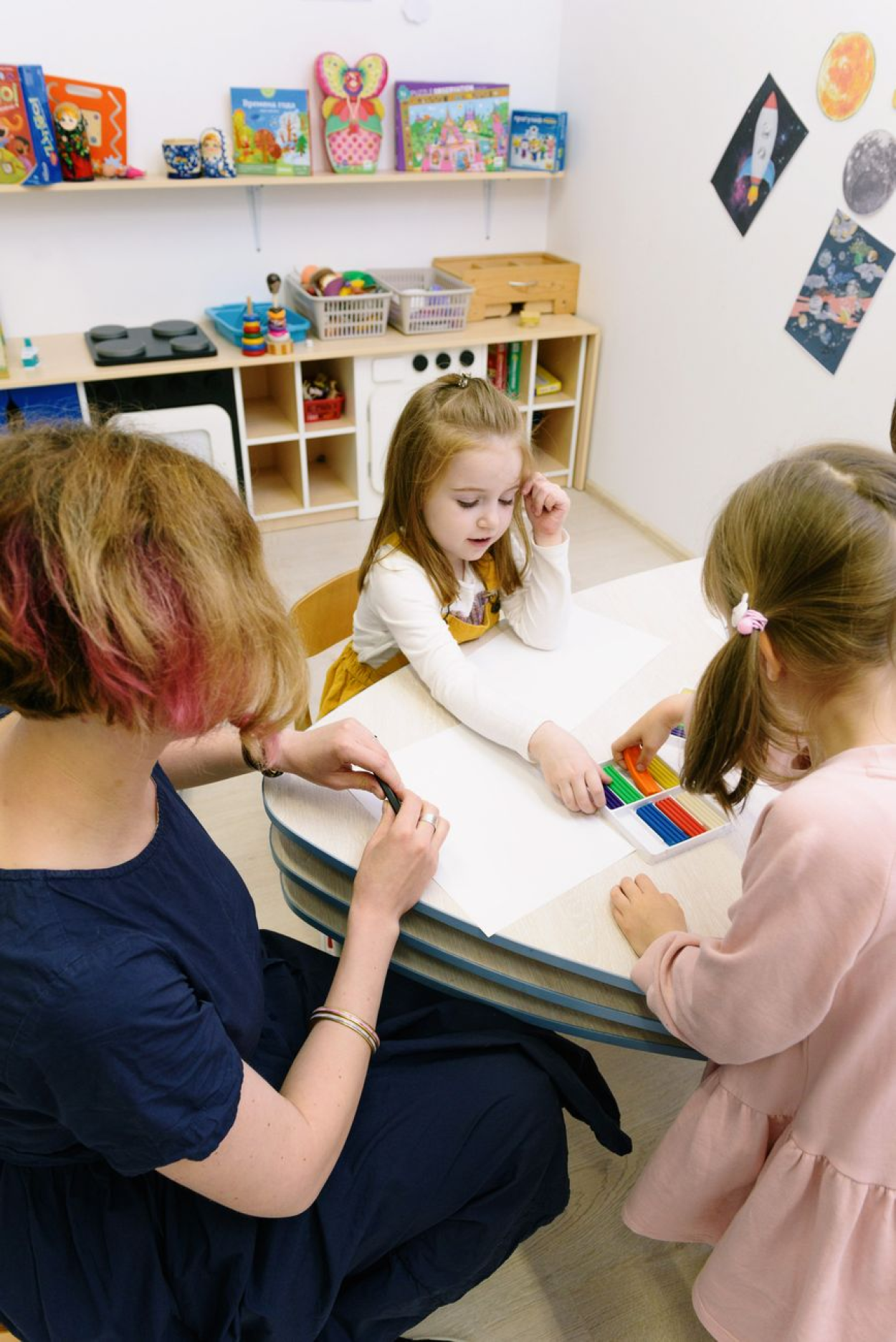
Mixed-age classrooms are one of the features families notice first when they explore Montessori early childhood education. In an authentic Montessori setting, children are not separated into narrow age bands and moved through the day as a single group. Instead, we prepare a learning community where younger and older tamariki can work alongside one another, usually across a three-year age span.
In our experience, this structure works well because it reflects how children naturally learn outside school settings. Younger children watch, imitate, absorb language, and build confidence through everyday contact with more capable peers. Older children strengthen their own understanding when they model routines, explain ideas, and contribute to the community. In Montessori, this is not an accidental by-product. It is part of the design of the environment itself.
For families who are new to the approach, mixed-age learning can raise understandable questions. Will younger children be left behind? Will older children be held back? How do teachers meet different needs at once? We hear these questions often, and they are important. The short answer is that mixed-age classrooms work because Montessori education is built around individual development rather than whole-group pacing. When the environment is carefully prepared and guided by trained kaiako, children are free to progress at the pace that matches their readiness.
If you are exploring how this works in practice, you can learn more about our approach to Montessori education and how the environment supports children’s day-to-day learning in our place.
In Montessori early childhood education, the classroom is typically designed for children aged around 3 to 6. Rather than every child doing the same activity at the same time, we prepare a space where materials are sequenced from simple to more complex, and where each child can work according to developmental readiness, interest, and prior experience.
This means a younger child may be practising practical life skills such as pouring, spooning, handwashing, or rolling a mat, while an older child may be working with early numeracy, language materials, or more advanced cultural activities. Both are learning, but they are not expected to be identical in pace or content.
We typically see the classroom function as a small community. Some children are brand new and are learning how to observe, choose work, return materials, and move carefully through the space. Others are in the middle of the cycle and are building concentration and independence. The oldest children often become steady role models who know the routines, care for the environment, and show younger classmates what respectful participation looks like.
This continuity matters. In Montessori, children usually remain with the same teaching team and peer group for multiple years. That stability allows strong relationships to develop and gives kaiako time to understand each child in depth rather than only for a short transition period.
We find that mixed-age classrooms work because they create learning conditions that are difficult to reproduce in a single-age, whole-group model.
Younger children learn a great deal before they are ready to do a lesson independently. They watch how older children carry materials, solve problems, speak to others, and complete a work cycle. This kind of observation is powerful because it is concrete, repeated, and embedded in the daily life of the classroom.
In practice, we often see a younger child become interested in work after quietly observing it several times. When that child is developmentally ready, the transition into active participation is more confident and more purposeful.
One of the clearest benefits of a mixed-age environment is what happens for older children. When a child demonstrates a routine, helps a younger peer, or models how to care for materials, they are not just being kind. They are strengthening memory, sequencing, communication, patience, and self-control.
In our experience, leadership in Montessori is usually quiet rather than performative. It may look like showing someone where to place a tray, waiting while a younger child tries something independently, or helping maintain the order of the environment. These small acts build maturity and a sense of responsibility.
Single-age settings can make it easy for adults and children alike to compare who is ahead and who is behind. Mixed-age Montessori classrooms shift the emphasis. Because children are working across a broad range of materials and developmental stages, the focus moves toward individual progress.
We often see this reduce unnecessary performance pressure. A child can spend the time needed to master a skill without feeling that everyone else must be at the same point. At the same time, children are still challenged because there is always visible next-step learning in the room.
Mixed-age grouping supports a classroom culture where children experience being helped, helping others, waiting, leading, following, and belonging. Those are not secondary outcomes. They are central to healthy early childhood development.
When we help children settle into Montessori, we are not only thinking about academic readiness. We are also supporting grace and courtesy, turn-taking, problem-solving, empathy, and respect for shared spaces. A multi-age environment gives children daily opportunities to practise those capabilities in meaningful ways.
Families sometimes assume mixed-age classrooms mainly benefit the oldest children, but we usually see benefits across the full age span.
That said, mixed-age learning is not simply a matter of placing different ages in one room. It works when the environment is intentionally prepared, the expectations are clear, and kaiako carefully observe each child’s developmental needs. Without those foundations, the advantages of mixed-age grouping can be lost.
For families in Aotearoa New Zealand, it is important to understand that Montessori early childhood education does not stand apart from the national curriculum context. In our setting, Montessori practice is supported by Te Whāriki and by the relationships, identity, and community values that Te Whāriki places at the centre of early learning.
We see a strong connection between mixed-age Montessori classrooms and the principles of Te Whāriki. Relationships matter deeply in a multi-age environment. Children learn through responsive and reciprocal interactions with people, places, and things. Family and community are also reflected in the classroom structure itself, because children participate in a shared social world rather than a narrow age silo.
Mixed-age classrooms also support equitable participation. Different children contribute in different ways at different times. A younger child may contribute curiosity, observation, and emerging participation. An older child may contribute steadiness, modelling, and care for others. Both belong, and both have mana within the community.
When we design our local curriculum, we are thinking not only about academic concepts or Montessori materials in isolation, but about the whole child within a living community. Families can read more about our philosophy and setting on our About page.
In our experience, no. Older children are usually extended rather than limited in a mixed-age Montessori classroom. Because the programme is individualised, they are not waiting for the whole group to catch up. They continue moving into more complex work while also developing leadership and social confidence.
Not when the environment is calm, orderly, and well guided. Younger children often benefit from entering a room where routines are already established. They can watch first, participate gradually, and build independence step by step.
Montessori teachers are not trying to run every child through the same lesson at the same moment. Instead, we observe, present lessons individually or in small groups, and maintain an environment where purposeful independent activity is possible. That is one reason the prepared environment is so important in Montessori.
Actually, we usually find the opposite. Montessori mixed-age classrooms rely on clear routines, carefully sequenced materials, consistent expectations, and respectful limits. The freedom children experience is purposeful freedom within structure.
| Feature | How it works in practice | Why it matters for children |
|---|---|---|
| Three-year age span | Children learn alongside younger and older peers | Supports peer modelling, continuity, and community |
| Observation-based learning | Younger children watch before doing | Builds confidence, readiness, and motivation |
| Leadership opportunities | Older children help model routines and care for the environment | Strengthens responsibility, empathy, and self-belief |
| Individual pacing | Children progress by readiness rather than whole-group timing | Reduces comparison and supports deeper mastery |
| Stable classroom culture | Experienced children carry forward habits and expectations | Creates a calmer, more settled learning environment |
| Alignment with Te Whāriki | Learning is grounded in relationships, belonging, contribution, and holistic development | Supports the whole child within a bicultural early learning context |
If you are considering a Montessori early childhood setting, we encourage families to look beyond the simple question of age grouping and instead ask how the classroom actually functions day to day.
In our experience, mixed-age classrooms work best when they are part of a coherent Montessori approach rather than an isolated structural choice. The real value is not simply that children are different ages. The value is that the environment is intentionally designed so those age differences become a strength.
If you would like to see how this looks in a real early childhood setting, we welcome families to contact us and learn more about our programme.
This article was produced by our internal Montessori Children’s House editorial team in collaboration with practitioners who work within early childhood education and childcare. We write from our experience supporting tamariki and whānau in an authentic Montessori environment in Miramar, Wellington, while also grounding our articles in recognised curriculum guidance and established Montessori practice. Our editorial process focuses on practical accuracy, family relevance, and alignment with Montessori principles, Te Whāriki, and the wider responsibilities of high-quality early childhood education.